Showing posts with label World War II. Show all posts

Thursday, July 3, 2014

The Pale House, Luke McCallin and a Giveaway


PaleHouse-coverThe flawed-but-determined German military investigator Gregor Reinhardt returns this week in THE PALE HOUSE, the follow up to author Luke McCallin’s critically praised The Man from Berlin.

I’m thrilled to welcome Luke here today to talk about this book and his writing. In addition, thanks to Luke and the lovely Loren at Berkley, I have 2 copies of THE PALE HOUSE to giveaway. Please see the end of the post for more details.

First a brief summary of THE PALE HOUSE

     In the bloody final days of World War II, two years after the events in The Man from Berlin, Gregor Reinhardt is transferred from normal army intelligence officer duties to service in a Feldjaegerkorps, a new branch of military police with extensive powers. This unit is sent south, to the Balkans, to help maintain the army’s discipline in the chaotic retreat from Greece and Montenegro into Bosnia. But in this new role, Reinhardt is cut adrift from friends and colleagues.
      Upon arrival in Sarajevo, Reinhardt is witness to a massacre of civilians by the Ustaše, a Croation fascist and terrorist organization. However, he discovers there is much more to the incident than meets the eye, and that the Ustaše are hiding something. Worse, as Reinhardt probes deeper into the apparent mystery, he uncovers increasing evidence of German collusion.
      Reinhardt must use his skills as a detective while struggling with both his own desire to survive the last days of the war against the moral imperative that crime must not go unpunished. However, he understands this is his moment to resist, and fight, even if it is to the death.

Now, please join me in welcoming Luke to Thoughts in Progress as he as graciously answered some questions for me.

Mason - What was your research process like for this book?


Luke:
I did not have a formal research process as I wrote. I knew a lot about the Balkans already. I worked there six years with the United Nations, and what I did not know I found easily enough. I used to think the novel could have been written in any number of places. It was originally to be in Berlin—a city about which I know nothing and to which I have never been—but when I thought of moving it to Sarajevo, it just seemed to fit so well. It made the research not only effortless, but enjoyable, especially when it began to validate much of what I thought and felt about what I had seen and heard during my time there.

That said, my research for the third Reinhardt novel is far more daunting. I’m taking Reinhardt to Berlin, onto what is for me unknown, emotional and historical territory. Terra incognita. I don’t know Berlin at all, so I do feel a bit overwhelmed by what I need to know, and what I think I need to know. At some point, I'm sure, I'm going to run into the infamous quandary a writer faces, between going with what’s right for the story, and what’s right factually or historically. I just hope I can find the right balancing act when the time comes.
 
Mason - Now that your book has been published, what surprised you the most about this project and its outcome?


Luke:
That I had stories that people liked to read, and characters people liked to care and read about! I'm surprised at how Reinhardt and his stories have found their niche, and I’ve been immensely touched by readers’ feedback. Not a day goes by that I'm not contacted by a reader with a short message of appreciation. Some have really engaged with the characters, with the story, with the time and place I write about. I really appreciate that, people taking the time to get in touch.
 
Mason - If you could write a book with any author (living or dead), who would it be and what would the book be about?

Luke:
Goodness, that’s a great question! There are two periods of history that particularly interest me: the beginning of the 19thnd 20th centuries. I find them to be periods of upheavals in science and sociology, in the way societies were formed and conceptualized and managed. They were periods of great advancements in science, in medicine, philosophy and art, in government, in technology, in human relations, but also periods of great risk and suffering. Of the two periods, the early 20thentury interests me more, with cataclysm of the First World War drawing a red line between two worlds. I would love, therefore, to write a novel set during, or about, the First World War, with one of the memoirists whose writing marked the period, such as Siegfried Sassoon, or Robert Graves.
 
Mason - Do you have any habits/rituals you follow when writing such as a certain place to write, favorite beverage to drink, quiet verses noise, etc.?

Luke:
Black tea, by the liter! I like quiet, but only relative. I work to music a lot. I have a particular soft spot for West African music, especially music from Mali. I used to work in Mali and it’s a musical goldmine, a gift that keeps on giving! I fell in love with the kora, which is a harp-like instrument, and is extraordinary in the hands of a master like Toumani Diabaté. It has an amazing range that can take you away, but it keeps you grounded as well.
 
Mason - What do you hope readers take away from reading your latest release?


Luke:
Writing the Reinhardt novels was not so much a question of could I do it—I had a degree of confidence in myself as a storyteller and a writer—but should I do
it. I was afraid that what I was trying to write could so easily have been misunderstood as an apology. The time, the place, a character such as Reinhardt—a German, a soldier, a servant, however unwilling of a regime such as the Nazis—when what I was trying to get at was the human aspect of one man caught between choices.


The watchwords to Reinhardt’s character and story are probably ‘change’ and ‘consequence.’ Reinhardt’s story is a thread woven into a tapestry of a continent in upheaval. He goes through those times initially just trying to keep his head above water and survive, but he changes. It’s impossible not to. I wanted to make people interested in those changes, interested in the consequences of those changes, and to make people believe Reinhardt has something to bring to the table, so to say. I wanted people to care about him, and to survive is not enough.
 
Above all, what I wanted to do in creating and writing Reinhardt was to make people think that he could be you. An ordinary man in extraordinary times, still trying to behave and believe in what makes sense, but so painfully aware of his own fears and limitations, and still knowing what is right and what is wrong. If you give someone like that an opportunity to do something, be someone, what would he do? What would you do…?

Mason - Are you currently working on any new projects?

Luke:
Yes, I'm completing the initial Gregor Reinhardt trilogy. I originally conceived of three books, with each one at heart covering a theme: redemption in The Man From Berlin, resistance in The Pale House, and reconciliation in the third. When those three are written, I’m going to dive back in for more! There’s a lot more I’d like to do with Reinhardt, and his times. 

Once the third Reinhardt novel in the original trilogy is written, I want to start working on a fourth book, which will show Reinhardt in the trenches. I always wanted to write a WWI book, and with Reinhardt I think I have the right vehicle. We’ll see him as a young man, faced with an investigation in the trenches at a time of utmost turmoil as the war begins to turn definitely away from the Germans, as men’s discipline begins to fray, and the tide of revolution begins to sweep from the east.

Luke, thanks for joining us and sharing this insight into THE PALE HOUSE. You have definitely made Gregor Reinhardt an intriguing character with many facets. 

Now let me share a bit of background on Luke.

Luke McCallin, author of The Man from Berlin, was born in 1972 in Oxford, grew up around the world and has worked with the United Nations as a humanitarian relief worker and peacekeeper in the Caucasus, the Sahel, and the Balkans. 

His experiences have driven his writing, in which he explores what happens to normal people—those stricken by conflict, by disaster—when they are put under abnormal pressures. 

For more on Luke and his writing, visit his website and connect with him on Facebook, Twitter, and Google+.

GIVEAWAY DETAILS …

This giveaway is for two (2) print copies of THE PALE HOUSE. The giveaway is open to U.S. residents only and will end Friday, July 11. 

To enter, just click on the Rafflecopter widget below and following the instructions. The widget may take a few seconds to load, so please be patient. The winner from this giveaway will have 72 hours to respond after being contacted or another winner will be selected. The email will have ‘Thoughts in Progress Luke McCallin’s Tour’ in the subject line, just so you know what to watch for (in case it goes into your spam folder).

Thank you so much for dropping by today during Luke’s visit. What is it that draws you to read books set in and around World War II?

*This post contains affiliate links. a Rafflecopter giveaway

Wednesday, February 5, 2014

The Roses Underneath and a Giveaway


Note: The winner of this giveaway is Carl S. Congratulations to Carl and thanks to everyone who entered the giveaway.

Please join me today in welcoming author C.F. Yetmen, whose post-World War II novel picks up where George Clooney’s new The Monuments Men movie leaves off.

In this exclusive interview with C.F., she discloses why she wrote
her novel, THE ROSES UNDERNEATH, plus the most surprising thing she learned writing it. In addition, C.F. is giving away one signed paperback copy of her book to a lucky visitor to Thoughts. Please see the end of the post for details.

Here’s a brief synopsis of THE ROSES UNDERNEATH:

August 1945, Wiesbaden, Germany. With the country in ruins, Anna Klein, displaced and separated from her beloved husband, struggles to support herself and her six-year-old daughter, Amalia. Her typing job at the Collecting Point for the US Army’s Monuments Men is the only thing keeping her afloat.
        Charged with securing Nazi-looted art and rebuilding Germany’s monuments, the Americans are on the hunt for stolen treasures. But after the horrors of the war, Anna wants only to hide from the truth and rebuild a life with her family. When easy-going American Captain Henry Cooper recruits her as his reluctant translator, the two of them stumble on a mysterious stash of art in a villa outside of town.
        Cooper’s penchant for breaking the rules capsizes Anna’s tenuous security and propels her into a search for elusive truth and justice in a world where everyone is hiding something.

C.F. joins us now and has graciously answered some questions. Welcome, C.F.

Mason –THE ROSES UNDERNEATH is such a fascinating story. What inspired you to write it?

C.F.:
I am delighted that you think so! The true experiences of my grandmother and my mother in Germany at the immediate end of World War II has always interested me. Because she spoke English, my German grandmother found work as a secretary for an American officer during the occupation. She credited this with saving her life. I wanted to tell that story in some way but didn’t know how to go about it. When I saw a documentary about the work of the Monuments Men I became totally fascinated by them and started reading all I could about them. That led to a convergence of ideas that created the setting for the novel.

Mason - What was your writing schedule like? Did you have a favorite place and time to write and did you listen to music?

C.F.:
I write best in the very early morning, so a lot of the book was written between the hours of four and six AM, before the regular day got started. But I also carved out other times whenever I could. When I wasn’t writing in my office, I was working on my laptop somewhere. I try not to be too precious about where and when I work, because you just have to take the opportunities when they arise and sometimes you are working against the clock. I did have a thing about music when working on the book – I only listened to Beethoven when I wrote, and usually I would start a writing session with the second movement of the 7th Symphony, which is just the most beautiful piece of music. Maybe it sounds pretentious, but there is something very heroic and steadfast about Beethoven that seemed to resonate with the ideas in the book. It did to me, anyway.

Mason - How did you go about doing research for your book?

C.F.:
The Roses Underneath coverI absolutely love research. I read a ton of books about German civilians’ experiences of the war, specifically women, but also German soldiers. There are more accounts of Wehrmacht—the regular army—soldiers coming to light now, so those were very powerful. Of course the books about the Monuments Men and Hitler’s art theft, and memoirs of several Monuments Men themselves were very helpful – and so interesting. About a year into my research the entire Monuments Men archive was put online, which was just about the best present I ever got. I would vanish for hours inside those pages. I also traveled to Wiesbaden and met with the city archivist who provided images of the city as it looked in 1945. I went the Landes museum, where the Collecting Point had been located and walked the streets surrounding it. It gave me a good sense of the place, which I knew would be important for the book. I also watched a lot of movies and documentaries. A lot.

Mason - After the book’s publication, looking back what was the most surprising thing you discovered while writing it?

C.F.:
In terms of the story, the thing that surprised me most was the character of Oskar. I had a plan for that kid, and he just refused to go along with it. I felt very much like Anna, trying to get information out of him to find out what his story was. He was one character that asserted himself into the story in a way I didn’t really know was possible. People talk about their characters taking on a will of their own, but I didn't really believe it until it happened to me. I think it had something to do with my not actually knowing his whole backstory. For all the other characters I was very clear on who they are, what their experiences of the war were, and what their point of view is. Oskar played his background very close to the vest. And he just refused to cooperate, so I had to figure him out as the story went along.

Mason - What advice would you give to someone thinking about pursuing a writing career?

C.F.:
The only advice I can give is if you want to be a writer, write. Learn the craft, seek out other writers, create an environment that supports your writing life. And don’t give up when it gets hard. Just keep going. And read, of course!

Mason - What can readers look forward to next from you?

C.F.:
I am working on the next book in the series. There is still so much in Anna’s life that she has to reconcile, and things at the Collecting Point get more and more interesting. With so much history to take inspiration from it is intriguing for me to see where these characters will go next.

C.F., thanks so much for joining us today and sharing this look at how your book came to be. Your research journey sounds fascinating.

Now let me share a bit about C.F.

C.F. Yetmen is a writer and consultant specializing in architecture and design. She is co-author of The Owner’s Dilemma: Driving Success and Innovation in the Design and Construction Industry and a former publisher of Texas Architect magazine. THE ROSES UNDERNEATH is her first novel. 

For more on C.F., visit her website and blog. You can also connect with her on Twitter, Facebook, Goodreads and Pinterest.

Here’s what some are already saying about this fascinating story:

“A fascinating tale of survival, intrigue, and Nazi looted art amid the ruins of 1945 Germany. It’s a world in which very little is what it appears to be and everyone has a story they don’t want to tell. The author exploits this place and time deliciously.”
James Kunetka, New York Times best selling author
“Fans of Alan Furst will be delighted with this debut novel from the perspective of WW II survivors as they dig themselves out of the rubble and face deprivation and dislocation under Allied command. Yetmen has created a fascinating and complex heroine torn between ‘good Germans and bad Germans’ and the Americans who struggle to occupy and heal a vanquished nation.”
Thomas Zigal, author of Many Rivers to Cross and The White League
“Yetmen turns the narrative of the Allied forces’ Monuments Men 180 degrees and gives us a German protagonist: a young woman who, with her daughter, has survived the war but now must figure out how to survive its aftermath. Yetmen rejects heroism and absolutes in favor of a more complex portrayal of postwar Germany and its American occupiers in which good can look like evil, evil can look like good, and no one is blameless. This page-turner from a talented new writer deserves a place on every historical fiction-lover’s bedside table.”
Kathy Leonard Czepiel, author of A Violet Season

GIVEAWAY DETAILS:

This giveaway is for one signed paperback copy of THE ROSES UNDERNEATH.

To enter, please send me an e-mail (mcbookshelf@gmail.com) with the subject line, “Win The Roses Underneath.” Your message should include your name and mailing address. The deadline to enter this giveaway for a chance to win a copy of THE ROSES UNDERNEATH is 8 p.m. (EST) on Friday, Feb. 14.

Thanks so much for stopping by today. Do you find this period of history intriguing? Are you planning to go see The Monuments Men when it opens in theatres Friday?

Wednesday, June 19, 2013

Author Ruth Francisco On Writing A WWII Novel


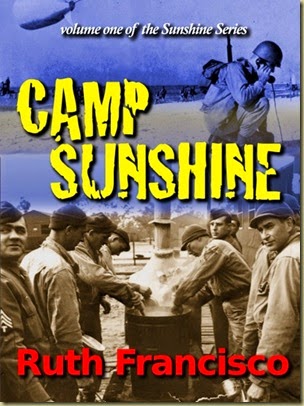
I’m delighted today to welcome author Ruth Francisco here to talk about writing a World War II novel and her latest release, CAMP SUNSHINE: Volume One in the Sunshine Series. She also has some amazing photos to share.

Ruth worked in the film industry for 15 years before selling her first novel Confessions of a Deathmaiden to Warner Books in 2003. She followed that with Good Morning, Darkness, which was selected by Publishers’ Weekly as one of the ten best mysteries of 2004,  and The Secret Memoirs of Jacqueline Kennedy Onassis.  She now has nine novels, including the best-seller Amsterdam 2012, published as an eBook. She currently lives in Florida.

Ruth, please tell us about your latest book.

Ruth:
CAMP SUNSHINE is based on the true story of Camp Gordon Johnston, a WWII amphibious training camp on Florida's Gulf coast.  


By the end of 1942, U.S. Generals had already committed themselves to invading the coast of France. They commissioned Anthony Higgins in New Orleans to come up with a boat, the “Higgins,” that could transport men and equipment onto shallow beaches. Then they had to train soldiers to use the boats. In three months, they built a training camp, Camp Gordon Johnston, in Carrabelle, Florida—a desolate area of swamps, alligators, biting insects, torrid summers, and tropical storms. A city rose from the jungle.

The story explores the intertwining lives of civilians and soldiers. Here, twenty thousand young recruits test themselves to the limitCampSunshineFinalBlue in love and combat; politicos and tycoons offer aid with one eye to profit; women patrol the coast on horseback, looking for German subs; a postmaster's daughter, the only child on base, inspires thousands with her radio broadcasts; and a determined woman bravely holds together her family and the emotional soul of the camp.  

But when Commanding Officer Major Occam Goodwin discovers a murdered black family deep in the forest, he must dance delicately around military politics, and a race war that threatens the entire war effort. Amid tragedy and betrayal, victory and terror, the fate of the soldiers and their country hangs perilously in the balance, as each endeavors to find his destiny.  

What's the most important thing in writing an historical novel as opposed to other fiction?

Ruth:
In a word, research. I did an incredible amount of research for this novel. The vastness of my ignorance when it came to WWII military history was epic, so I had to do epic amounts of reading. I interviewed WWII vets. I visited WWII museums, especially photo archives. I watched WWII Army training films. Camp Gordon Johnston had a newspaper written by the troops, called “The Amphibian,” and I spent a month reading every issue on microfiche.  


I love the way research can surprise you and lead you in new directions. I learned of the Double V campaign, which was an African-American civil rights movement intent on integrating the armed services during WWII. Suddenly, I found myself with a subplot, which added depth to the novel. It made the story important.

What is the hardest thing for historical fiction writers?

Ruth:
I think one of the most difficult things for any writer is how to incorporate the backstory—the histories of all the characters and places—into your narrative. If you start off giving too much information, you bore the reader, so you attempt to parcel out information as you go along. If you can do it in a way that surprises the reader, that's even better. For instance, having a character's behavior seem irrational, but later you learn why she reacted that way.

For a historical novel, it is even more challenging. After you've done all this research, how do you write an engaging narrative while piling in the information you want to add?  

When writing historical fiction, how free can you be with historical fact? It is fiction, after all.

Ruth:
Certain things you can't mess with. Big events. You can't have the bombing of Pearl Harbor on December 8, 1940. If your characters talk about the song “White Christmas” in 1942, you better be sure that it was written by then. Your readers are smarter than you are. They know more history. They make sport of catching oxymorons. 


DanceWith lesser known events you can use “artistic license,” especially for little known historic characters. For instance, I read that two twelve-year-old girls ran a radio station out of Panama City for WWII pilots in training. So I had my postmaster's daughter do the same thing, although the “real” postmaster's daughter was not a DJ. I changed the names of some of the officers who ran the camp because I wanted to involve them in a crime. You can make an historic character a murderer, but you have to be careful. It has to make sense.  

In other words, with minor characters, motivations, thoughts, and feelings—let your imagination run wild. Historic events, details—stick to the facts.  

Do you have any “tricks” for historical novel writing?

Ruth:
I study photos. I study the clothes and hairstyles. I try to imagine what the people are thinking in the picture, what came before the picture was taken, what came after. When I wrote “The Secret Memoirs of Jacqueline Kennedy Onassis,” I wrote almost exclusively from pictures. For instance, the famous picture of Jackie leaving the White House for the inaugural ball—I started with the event, then had her remember all the events that led up to that moment. One picture was an entire chapter.


In this book, I was particularly captured by the photos of WWII training maneuvers, and tried to imagine how an eighteen-year-oldWomenSewing boy would react to having bombs explode all around him, waist-high in a swamp, stepping on creepy-crawly creatures. How frightened he must've been. There's a picture of civilian women sewing uniforms for the soldiers, and I get such a sense of dedication and sacrifice—so alien to our culture.

I also read a lot of fiction from the era, which is loads of fun, attentive to jargon, word usage, and attitudes. I listened to a lot of WWII era radio, G.I. Jill, Command Performance, all those great WWII shows. I also studied the pop culture of the era, the songs and dances.
You cannot assume people in another era would behave as you might to a situation.

I recall seeing the 1982 film “The Return of Martin Guerre,” set in 16th century France, how tense and wild the people seemed, and it struck me profoundly—if you lived in an environment where you were constantly challenged, constantly on guard for a knife, constantly suspicious, constantly hungry, of course it would make you different. Writers often get caught with their characters having the same values and feelings of contemporary people.  But people ARE different. The lines they will not cross. Their values. Their expectations. You have to use all the resources available to put yourself there. Imagine with all five senses, how the air smells and tastes and feels on your skin.

Why did you add a mystery element to an historical novel?

Ruth:
The reason I tend to stick to the mystery/thriller genre, even when I'm writing an historical novel, is that I think it really helps to focus storytelling. A mystery demands a certain pacing. It demands parceling out of clues and information. It forces you to reveal character through action. I feel it really helps me as a writer to have a structured genre.


Where did you get the idea for your WWII story?
 
Ruth:
When I first drove to the Florida Panhandle from Los Angeles five years ago, I was smitten by the  unspoiled beauty of the place. Thousands of Monarch butterflies flitted around my car as I drove down to Alligator Point. The first morning I woke to mullet LongClowLinejumping in the canal and screeching great blue herons. I looked out the window and saw snowy egrets and bald eagles. White squirrels jumping between branches of the pine trees. I had to write about this area.


One day I met a fisherman throwing a cast net into the water and asked him to show me how. We got to talking. When he heard I was a writer, he told me a local story about several dozen soldiers who lost their lives during a WWII training exercise while at Camp Gordon Johnston, how the tragedy was covered up.  

So a few weeks later, I visited the WWII museum in Carrabelle. I got completely sucked into the research. Everything fascinated me—especially the newspaper advertisements—from girdles to hair tonic. I started interviewing locals. Everyone had something to add.  

I got overloaded with info, and had to step back for a few years. It wasn't until I interviewed Vivian Hess, who had been a little girl on the Army base, that I felt I had a hook. Her stories were enchanting. I had a story. 
 
How do you keep a book character driven when you have historical events that have to be covered?


Ruth:
You almost have to approach your characters as if you were an actor, imaging how YOU would feel, how YOU would react to historical events.


Despite all the WWII coverage, CAMP SUNSHINE is definitely character driven—told from the voices of an officer, a soldier, a little girl, and the wife of the postmaster. However, there were some factual events—like the drowning of dozens of soldiers in a training incident—that I had to include in the plot. And there were other historical elements I wanted to include, like the Black Regiments, and the Higgins crafts. It was hard, but extremely enjoyable to figure a way to integrate them into the story.
 
How do your characters “come” to you? How closely are they based on real characters or people you know?

Ruth:
The character Vivian Thatcher is based on my interviews with Vivian Hess, the real postmaster's daughter. Yet, as I wrote about her, the character separated herself from the real person, becoming increasingly impish and inventive. I wanted Major Goodwin to be a man of absolute integrity, but as I wrote him, he took on depth, becoming a man of great sorrow and great compassion. Vivian's mother was somewhat based on my own mother, but soon she became this incredibly strong woman who'd made great sacrifices, yet still yearned to be adventurous and free.


In my experience, you have a vision for your characters, but then, as the story unfolds, they become their own person. Some take on characteristics of friends and family. The imagination works from what it knows. It is a little odd. Like giving birth to children—you don't really know how they'll turn out. Inevitably, they turn out more interesting than you could possibly imagine.

What do you hope your readers come away with after reading your book?

Ruth:
I hope readers will feel as if they’ve time-traveled back to 1943. They'll hear the big band music and blues, and sense the incredible vitality of the whole country pulling together for the war effort.  It CGJBlackTroopsinspires me how selfless people were. When I started the research, I didn't know that the Civil Rights Movement had its beginnings in WWII with soldiers agitating for an integrated military. I didn't know about jook joints. I didn't know about how the industrial war complex manipulated the war effort, how it all affected race relations in the South. So I hope readers will be as fascinated as I was with the history, as well as being entertained with the antics of the characters.


You have been traditionally published by two big publishers. Why did you decide to publish directly to Kindle?  

Ruth:
I got started publishing on Kindle several years ago. My publisher turned down my fourth book AMSTERDAM 2012 which was highly controversial. The fatwa against Salman Rushdie and his publishers was still fresh in their minds. So I published to Kindle and sold 1000 books the first weekend. I suddenly realized how quickly the whole publishing industry was changing.


At one time, agents discouraged writers from publishing on Kindle, thinking it would prevent the book from getting sold to a traditional publisher. But that is no longer true (FIFTY SHADES OF GREY case in point). Traditional publishers now routinely offer contracts to people who have published eBooks. I no longer have patience to wait for my agent to sell a book. That can take six months. Then a year to get published once you sign a contract.  

I'd encourage all new writers not to wait for an agent. Don’t wait for a publisher. Write the best, most truthful book you can, then publish on Kindle. You can immediately make some money from your writing, which makes you feel like a writer. You get immediate feedback from readers, which is exciting, improves your work, and makes you realize that, yes, you are writing for an audience. You can make changes on your published material. Traditional publishing is on its way out: it is no longer economically sustainable for publishers; it is too slow to respond to the marketplace; and people are more mobile than ever—they don’t want to lug around a library of books every time they move. 

Simply put, Kindle writing is the future of writing: exciting, dynamic, and very likely more profitable for writers. It makes literature suddenly relevant to readers in a new way.

Where can we go to buy your book?

Ruth:
Amazon

 
Ruth, thanks so much for visiting with us today. You have definitely put a lot of research into writing CAMP SUNSHINE and it shows.

For more on Ruth and her writing, find her on Twitter@kayakruthie and on Facebook at Ruth Francisco, author@Facebook.com

Thanks everyone for dropping by today. Don’t you just love the old photos? I can see how one photo can tell a story all by itself. Have you ever looked at a photo and wondered what it’s history was?

Friday, December 7, 2012

Author David LeRoy: The Siren of Paris Tour

 
It’s my pleasure to be a participant in the promotional tour for author David LeRoy’s debut novel, THE SIREN OF PARIS, which explores the French Resistance and other events during World War II.

Here is a synopsis of David’s novel:
Born in Paris and raised in the United States, 21-year-old Marc Tolbert enjoys the advantages of being born to a wealthy, well-connected family. Reaching a turning point in his life, he decides to abandon his plans of going to medical school and study art in Paris. In 1939, he boards a ship and heads to France, blissfully unaware that Europe -- along with the rest of the world -- is on the brink of an especially devastating war.


When he arrives at l'École Nationale Supérieure des Beaux Arts, more ominous signs surface. There are windows covered with tape, sandbags shielding the fronts of important buildings, whispers of Parisian children leaving the city, and gas masks being distributed. Distracted by a blossoming love affair, Marc isn't too worried about his future, and he certainly doesn't expect a Nazi invasion of France.

Marc has a long journey ahead of him. He witnesses, first-hand, the fall of Paris and the departure of the French government. Employed by an ambassador, he visits heads of state, including the horribly obese gray-haired Mussolini and the charismatic Hitler. He witnesses the effects of the tightening vise of occupation, first-hand, as he tries to escape the country. He also participates in the French resistance, spends time in prison camps, and sees the liberation of the concentration camps. During his struggles, he is reunited with the woman he loves, Marie, who speaks passionately of working with the resistance. Is she working for freedom, or is she not to be trusted?

David has graciously answered some questions for me about his book and his writing.

Mason - If you had to write this book over, would you do anything differently - content in the book, your writing schedule, the way you researched it, etc.?  

David - I have recently received very frank feedback, from an industry insider, that the story needed to be changed for more mass-market appeal. I do not have long descriptive scenes of Paris streets, I lack weather details, and they wanted Marc to rescue Marie from her involvement with the Gestapo, rather than becoming her victim. The book stands in strong contrast to other novels of Paris during this time. 

There are three things I would do differently. In the basement scene on June 3rd when Paris is bombed, I would show the reader that Marc and the embassy staff are afraid of getting hit by bombs and drowning in wine, because Ambassador Bullitt had a collection of 18,000 bottles of wine in that building. The second thing I would change, and I am seriously considering doing this in a 2nd edition, is to reveal the identity of the mysterious German agent Marie takes under her guidance and teaches the fine art of entrapment of Resistance members, along with emotional and mental torture. This mysterious German agent is Klaus Barbie. I intentionally hid this in the book, however some people have figured it out. If you read that scene closely, it is clear that Marie is teaching this agent her techniques; he is later transferred to Paris.  The idea that Marc could save Marie from the Gestapo is very romantic, but not at all realistic. Klaus Barbie is not well known today, and his trial was over 25 years ago but he was an amazing monster. In this book, he is Marie’s student, not the other way around. 

 
Third, I am going to change the cover. It will be a crest of three Fleur de lis of crushed egg shell, one for ghosts of the past, one for prayers, and one for regrets, bound by a single gold ring representing Marc’s engagement to Marie. This is woven into the first chapter of the book. I think the current cover gives readers the idea that this is a war romance, or a thriller, instead of a serious historical novel. At the time the cover seemed to capture the story, but now I wonder what I was thinking when I chose it.  

I would not change the flashbacks in the second part of the story, because every step in Marc’s spiritual journey is carefully considered. Some have suggested cutting some of these characters as if they were just fillers. 

Mason - Did you find any fascinating tidbits of information during your research that you couldn’t use in your book?
 
David - Tons and some will be explored in the book that follows this one. One of the most unusual facts was that Winston Churchill was crossing the channel in a pink airplane, in German controlled airspace, as Paris fell. Because I use third person limited perspective in the book, I do not dive into much exposition going beyond Marc’s point of view. However, when I was close to completing the story, I discovered that in May of 1944 the German Police had posted a job announcement for undercover agents to work, in Paris, against the resistance. Over 6,000 applied for the job. For Marc that makes little difference, because he is already in the hands of the most experienced one of all. But for most in the resistance movement, which included many teenagers, this meant death, usually in the parlor room of 180 Rue de la Pompe. Some historians have questioned the size and scope of the resistance movement, but I think they fail to account for the high number who didn’t survive long enough to be counted after the war.  

Mason - Why write this book? What made this story so compelling to you that you had to tell it?
 
David - I faced a decision, early on, about what kind of story I would write. One would be more along the lines of the typical Siren of Paris by David LeroyWorld War II novel, full of intrigue, spying, and of course the victorious hero in the end. But all the people I read about were not exactly intact. They were haunted by the past and had experienced terrible things, especially betrayal on a very personal level, which scarred them for life. When I discovered that even to this day, survivors, and families of the victims of the RMS Lancastria have not been recognized, or even had the ship declared a war grave, I decided I had to explore betrayal and overcoming survivor’s guilt because it is still real to this day. 

The people who read the book and are the most moved by it have been relatives and children of French Resistance members, because they finally understand why their loved ones never talked about the war and never bragged about their victories. Marc is not a typical hero in the sense of our modern novels, but more of a wounded healer. Through the point of view of his mystical consciousness, the reader experiences a glimpse of hope that, one day, there is release from this war that took an estimated 69 million lives and promise of eternal peace. The inspiration for this unique structure comes from the Egyptian Book of the Dead, which is the story of the soul Ani traveling through the underworld until he reaches the most sacred space, eternal peace. This transforms the historical characters in this novel into a pantheon of both demons and gods. 
 
Mason - Is there any advice you’ve been given that you pass on to writers just beginning?  


David - Study various kinds of story and plot structure. I know that screenplay books are about writing screenplays, but the tools they teach about crafting a story are valuable.
 
Mason - With the book’s release, as you look back what was the biggest surprise that occurred in writing the story?  

David - THE SIREN OF PARIS is nowhere near a bestseller. It is not the number of people who read it, but who reads it that shocks me the most. I have had emails from people with relatives who were in the Paris resistance. Recently, there has been attention, in England, to details in the book about the RMS Lancastria. I do not cover the ultimate fate of Marie in this book, and that is not a mistake. However, some are now asking if this person is alive, and how do I know these details because she would be 92 years old, and a wanted war criminal.
 
Mason - What can readers look forward to next from you?
 
David - I have several projects going, but I plan to release a novella titled THE FLOWER OF CHAMULA in 2013. It is more of a character driven novel; it explores overcoming terminal illness and how it can prevent someone from living fully in the present. My fascination with the mystical and spiritual side of life will be evident in this work. It is set in San Cristobel de la Casa Mexico, in the Chiapas Mountains very close to one of the few places where the Catholic Church has been kicked out completely and replaced with a local form of Shamanism. Photography is not allowed, the floor of the church is covered in pine needles, the air is thick with the smoke of copal, and the veil is thin between the worlds.  
Siren of Paris Header
David, thank you for joining us today and sharing these details about your book. I had to laugh when I read about Winston Churchill in the pink airplane. There has to be a story there. Smile

Now let me share a bit of background about David. A native of California, David received a BA in Philosophy and Religion at Point Loma Nazarene College in San Diego. After returning from a European arts study program, he became interested in the history behind the French Resistance during World War Two. Writing fiction has become his latest way to explore philosophical, moral and emotional issues of life. THE SIREN OF PARIS is his first novel. 

For more information on David and his writing, visit him at http://www.thesirenofparis.com/.

Here is what one reviewer has to say about THE SIREN OF PARIS“This self-published novel really exhibits the amount of time and effort that its author took with his research. Mr. LeRoy takes his readers through the streets of Paris and shows the way the Parisian people were ignorant of the true toll of the war before it rolled down their own streets. He also uses many events of the time period, some that are well-known and some that are less known. I think even readers who are fond of World War II novels will learn about the underground resistance in Paris and the wartime tragedy of the RMS Lancastria.”

Here’s a book trailer for THE SIREN OF PARIS.


Thanks everyone for stopping by today. Do you enjoy stories based in fact and set during World War II? Is Paris one of the cities you love to read about no matter the era?

Wednesday, November 28, 2012

Author Karen Fisher-Alaniz: A Father/Daughter Journey


With each passing day a bit of history slowly vanishes as we lose the brave men and women who served in World War II. Many of those who lived through the events of that war have never spoken about it or only shared brief glimpses of what happened for various reasons. 

Author Karen Fisher-Alaniz recently came to understand much more about what her father did during the war and who he is. Karen joins us today as part of her WOW! Women On Writing Blog Tour for her book, BREAKING THE CODE: A Father's Secret, A Daughter's Journey and the Question That Changed Everything.

On his 81st birthday, Karen’s father presented her with two weathered notebooks containing more than 400 pages of letters he’d written to his parents during World War II. He asked her to uncover a truth for him, was he involved in espionage during the war or not. He had been forbidden to keep any written records and it was so many years ago. Thus began Karen’s journey that lead to her incredible book which is a double memoir: the story of her father's memories of his World War II service and the story of Karen, searching through history for clues to her father's part in winning World War II.

Thanks to Karen and Jodi at WOW!, I have a copy of BREAKING THE CODE to giveaway. Please see the end of the post for the guidelines and also an additional giveaway.
Here’s Karen to answer some questions about her journey to writing this book.

Mason - Why did your father believe he had been involved in espionage all those years ago and why his long wait to find out the truth? 

Karen - He believed he was, because he was. Before being sent to Iwo Jima an28d Okinawa to copy the top secret code based in the Japanese, Katakana, there were classes that his team was required to take. There were five in the team. They were told that if they revealed anything about what they did during the war, that they would be put in solitary for the remainder of the war. If anything they revealed got into enemy hands, they would be shot, without court martial. I think that fear, coupled with the great loss he experienced, locked the memories up. He was able to come home from the war, get married to my mother, have three daughters and work for the railroad for many years. I believe his mind protected him from the things he experienced – the things he saw. 9/11/2001 seems to have been a trigger for him – after that, he was quite down, and eventually nightmares and flashbacks were so common that he was afraid to even take a nap in the afternoon. He changed dramatically.

Mason - How does one even begin to uncover such secrets? Was it a difficult path to follow?
 
Karen - It was a long and very slow process. I would read some letters and then have a list of questions. Sometimes he’d answer the questions and often he wouldn’t, or couldn’t. My only goal at the time was to find a way to help him. I struggled many times with whether I was helping him or hurting him. I felt guilty when a memory came to the surface that was painful. But at the same time, I had a sense that in the long term, it would help him. 

Mason - What was one of the most surprising things yo
u discovered in your journey either about your father's activities, your father himself, your father/daughter relationship, or about yourself?
 
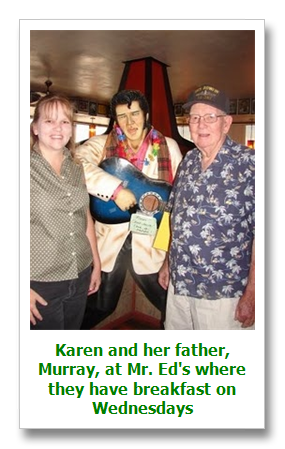
Karen - Well, I was sitting across from my father every week at a local diner. My father was now in his 80’s, walked with a cane, and his body was slowing down. His mind remains sharp as a tack. His memory is better than mine. But I’m sitting across from him, and trying to reconcile what I’m seeing with the young man he had been. 

My father had transferred from ship to submarine, to raft, to ship again, in the middle of the ocean. He’d scaled the side of a ship with radio equipment strapped to his back. He had copied a top secret code while Kamikazes filled the sky and comrades were dying around him. Before this, my father had just been Daddy. He was the one who taught me to ride a bike and who made campfires and roasted marshmallows. Seeing my father with new eyes was the most amazing experience of my life.

Mason - Before the request to uncover the truth, did your father talk much about the war and his part in it?
 
Karen - When I was little, my father had a handful of stories that he told over and over. But those stories made the war sound like Boy Scout camp. They were fun or interesting stories. There was nothing intriguing or dangerous sounding. When anyone asked him if he was in the war he would answer with an emphatic “no!” He believed that designation was reserved for those who were in hand-to-hand combat. 

My father often said that he had simply worked behind a desk during the war. That’s why, when he began having symptoms of Post-traumatic Stress Disorder, at the age of 81, I was so baffled. If he was so safe during the war, then what could have happened to bring on nightmares and flashbacks?

Mason - How long did your journey to discover the truth take you?
 
Karen - Dad started having flashbacks and nightmares at the age of 81, shortly after tragedy struck our nation on 9/11. I knew something was terribly wrong, but couldn’t figure out just what. So, we started having breakfast together once a week. Eventually, he gave me 400 pages of letters he wrote during the war. Those letters became the foundation for the story and the focus of our weekly conversations. I started asking him questions. I had a feeling that I would uncover something, and hopefully that would enable me to help him through this. I just never could have dreamed that my father was a top secret code breaker!

Mason - What advice would you give to others who would like to research their own families' involvement in the war?
 
Karen - Many of us have heard bits and pieces about our parent’s or grandparent’s wartime experiences. Or we’ve seen the proverbial wall come up when we ask about it. I think the important thing to do is to keep asking. Your loved one has a story to tell. Maybe they weren’t ready to tell it 30-years ago, or three weeks ago, but today could be the day. Give your loved one (and yourself) the gift of time. 

My father and I began having breakfast together once a week. That’s just one hour, every week, for ten years now. It adds up. Be willing to build a new relationship, one
that is different than when you were a child, or a teen, or young adult. I didn’t have time for my father’s stories during that time. It pains me to admit that. But it’s true. We all think we have more time; sadly, time runs out for some. And those stories are lost forever. I’m very thankful that Dad finally shared his stories with me.

Mason - Does your father have a favorite memory of the war.
 
Karen - He was stationed on Oahu, so he often went exploring by himself or with comrades. There was a little hole-in-the-wall steakhouse that he went to with his best friend, Mal. It was called, Mary’s Steakhouse. He got to be a regular, so one day, Mary asked him if there was something special she could make them that would remind them of home. Dad didn’t even have to think about it. Strawberry Shortcake. The next time he went in, Mary had made them homemade strawberry shortcake. He says it was the best he’s ever had. It’s a bittersweet memory because his comrade and friend didn’t survive the war much longer. But a beautiful memory none-the-less.

Karen, thank you for joining us today and sharing this insight information with us. You are so right saying we believe we have time to find out information from our loved ones, but we don’t. 

Karen was born and raised in Washington state. She taught special education for fourteen years before embarking on a new path as a writer. Although she'd been writing for fun since first grade, she'd never considered writing a book until her father handed her his collection of letters. Since then, she's toured bookstores and other events signing her book, inspired audiences with her public speaking, and was even interviewed by NPR's Audie Cornish for the Weekend Edition. 

Currently Karen has two new books in the works. The first is a humorous look at raising a child who has Attention Deficit Hyperactivity Disorder. The second and longer term book is a narrative nonfiction about another veteran's story. It is about Michael G. Reagan, an extremely talented portrait artist who gave up his career and has dedicated his life to drawing the portraits of fallen soldiers of the wars in Iraq, Afghanistan, and other wars. He donates the portraits, framed and free of charge, to the families. For more information about the Fallen Heroes Project, visit http://www.fallenheroesproject.org/

Karen lives in Walla Walla, WA. For more on Karen and her writing, visit her website at http://www.storymatters2.com/ and find her on Twitter at @karenlalaniz.

Now for the giveaway guidelines. To enter, send me an e-mail (mcbookshelf@gmail.com) with the subject line, “Win BREAKING THE CODE.” Your message should include your name and mailing address. And, just so you know, I don’t share this information with anyone other than the publisher nor use it for any other purpose. The deadline to enter this giveaway for a chance to win a copy of BREAKING THE CODE is be 8 p.m. (EST) on Thursday, Dec. 6.

You can also try your luck for one of three books Karen is giving away on Dec. 7. For more information and to enter, visit http://www.storymatters2.com

For those on Twitter, the hash tag for this tour is #BreakingTheCode.

Thanks everyone for stopping by today. Have you taken the time to listen to a family member’s wartime experience?