Showing posts with label psychological thriller. Show all posts

Thursday, August 25, 2016

The English Teacher {+ Giveaway}


Former Israeli intelligence officer and bestselling author Yiftach Reicher Atir has turned to writing spy thrillers, making his English-language debut with THE ENGLISH TEACHER (A Penguin Books Original; On-Sale: August 30, 2016; 9780143129189; $16; translated by Philip Simpson).

This is a thrilling, psychologically nuanced story of a rogue Mossad agent and the handler tasked with tracking her down and bringing her in, despite and because of their complicated personal and professional history. Reicher Atir served as a brigadier general in the Israeli Intelligence service, only beginning to write during his retirement.

After attending her father’s funeral, agent Rachel Goldschmitt empties her bank account, makes a cryptic phone call to her former case officer, Ehud, and disappears entirely. With her head full of classified information, Mossad can’t let her go, so they send Ehud to track her down. Finding no leads, he must search through her past to figure out why she abandoned Mossad—and whether she intends to betray them. But undercover life begins to blur Rachel’s true identity and her cover, and her love and loyalty are caught between the two. In the midst of a high-risk, high-stakes investigation, Ehud begins to question whether he ever knew his agent at all.

THE ENGLISH TEACHER is a classic spy novel with an intriguing twist, offering an insider’s view of the Mossad and authentic insight into the murky ethics and loyalties of life undercover. Perfect for fans of John le CarrĂ©’s novels and of Showtime’s Homeland, this novel introduces readers to a fascinating, unique new voice in the psychological thriller genre.

This is a classic spy thriller by a former Israeli intelligence officer, what could be more intriguing.


Author Yiftah Atir, photo by Eric Sultan
Yiftach Reicher Atir was born in 1949 on Kibbutz Shoval, in the south of Israel. 

As a young commando officer, he participated in Operation Entebbe and other military and intelligence operations before retirement with the rank of Brigadier General (Intelligence).

THE ENGLISH TEACHER is his third novel, and movie rights have been optioned by the original producers of Homeland.

THE ENGLISH TEACHER: A Novel
By Yiftach Reicher Atir
Penguin Books Original
On Sale: August 30, 2016
ISBN: 9780143129189
$16.00

Praise for THE ENGLISH TEACHER (also available in eBook):

“Absorbing…a fascinating look at Rachel’s undercover career in the Arab world…readers are treated to all the granular frustrations, mundane indignities, and utter loneliness that can accompany undercover work, details rarely covered in most tales of espionage.” — Publishers Weekly
          “[Reicher Atir] appreciates subtle spycraft and knows his business…” — Kirkus Reviews
          “Reicher Atir writes with poetic authority of the bleak isolation that pervades the life of the spy long after their active existence is over. This black yet strangely beautiful tragedy will stay with me for a long time.”— Alex Marwood, Edgar Award-winning author of The Wicked Girls
“An extraordinary page turner, told with clarity, insight, and compassion, THE ENGLISH TEACHER offers a rare and realistic portrait of the unrelenting sacrifices of living a double life.” — Gideon Raff, creator of Homeland
“Reicher Atir...probes how leading a double life can erode the foundations of a spy’s former existence; how all of the lies are rooted in truth, and the truth, especially when it comes to love, is often coated with a patina of lies... And Reicher Atir...is masterful in his depiction of this inner world and the scars it leaves over time.”— Mitch Ginsburg, The Times of Israel 
“The book... does exactly what a novel of its kind should do: re-examine the Mossad. Throughout the book...doubts are cast on personal as well as national morality...Reicher Atir asks where the line is that separates the moral actions that operatives perform for their country and exploitation by their country.” — Yiftah Ashkenazy, Ha’aretz


Thanks to the wonderful folks at Penguin Random House, I have a print copy of THE ENGLISH TEACHER by Yiftach Reicher Atir to giveaway. The giveaway is open to residents of the U.S. only and will end at 12 a.m. (EST) on Friday, Sept. 2.

To enter the giveaway, just click on the Rafflecopter widget below and follow the instructions. The widget may take a few seconds to load so please be patient. A winner will be selected by the Rafflecopter widget and I’ll send an email with the subject line “Thoughts in Progress Giveaway.” The winner will have 72 hours to reply to the email or another winner will be selected. PLEASE be sure to check your spam folder from time to time after the giveaway ends to make sure the notification email doesn’t end up there. If you win and you’ve already won the book somewhere else or you just decided for whatever reason you don’t want to win (which is fine), once again PLEASE let me know.

Thanks so much for stopping by today. Are you a fan of classic spy thrillers? Do you have a favorite author who writes spy thrillers?

Tuesday, March 22, 2016

Lacy Eye {+ Giveaway}


I’m excited today to welcome author Jessica Treadway to Thoughts in Progress to talk about writing genres and her latest release, LACY EYE.
Thanks to Jessica, I have a copy of LACY EYE to giveaway to one lucky visitor here. Please see the end of the post for more details on the giveaway.
Inspired by an actual crime in the author’s upstate New York hometown, this harrowing novel follows a mother’s slow awakening to the prospect that her daughter may have had a part in a violent attack that left her widowed, permanently disfigured, and suffering from a traumatic brain injury. Reviewers universally praise the novel including The Chicago Tribune, The Boston Globe, Good Housekeeping, and The Huffington Post among others.  
What if you began to suspect that the child closest to your heart—the cherished, vulnerable daughter you thought you knew better than anyone—might be a stranger capable of evil? In her acclaimed psychological thriller LACY EYE (Grand Central Publishing; March 1, 2016; Trade Paperback; 9781455554072; $14.99), Jessica explores the potential cost of choosing to believe what we prefer to be the truth – even in the face of evidence to the contrary.
Three years have passed since Hanna Schutt survived the brutal home invasion that killed her husband, Joe. Now, the man found guilty of the attack -- Rud Petty, the too-good-to-be-true boyfriend of her daughter Dawn -- has won a new trial on appeal.
Along with circumstantial evidence, Rud’s first conviction hinged on Hanna’s silent, semi-conscious confirmation of his guilt to a detective at the crime scene. To Hanna’s dismay, courtroom testimony also revealed she nodded when the detective asked, “Was Dawn here too?” “The Nods,” as a local tabloid reporter coined them, fueled the prosecution’s effort to indict Dawn on charges of murder and attempted murder. To Hanna’s relief, the effort failed, and Dawn moved across the country.
With the re-trial rapidly approaching, Hanna’s memory has started to return via terrifying flashbacks of that night. When approached about testifying again she agrees, knowing that another conviction is the only way to keep Rud in jail. Further, if she can testify as to what actually happened, she can once and for all prove Dawn’s innocence. Just after promising the prosecutor that she will do her best to recall the grisly event that left her memory impaired, Hanna receives a phone call from Dawn, who is living in Santa Fe. “I want to come home for a while,” her daughter says. “If you’re really going to do this -- try to remember what happened -- I don’t want you to do it alone.”
Hanna is thrilled at the idea that she might rekindle the companionship and intimacy she shared with her younger daughter, which she never felt with Dawn’s older sister Iris. Despite warnings from friends and internal unease, Hanna welcomes Dawn home with open arms, and begins to suspect a neighbor's son of committing the attack. Gradually, the lost memories surface, and Hanna is forced to confront the truth about that fateful night.
Told from Hanna’s perspective, LACY EYE is a chilling work of fact-based fiction forcing readers to face tough questions about the nature of truth and how responsible a parent is for what their child becomes.      
Here’s what others are saying about LACY EYE:   
          "Quietly disturbing...nail-bitingly suspenseful.”— The Columbus Dispatch
"Deftly plotted... Treadway paints a devastating portrait of a family torn apart from both the outside and within.” — Publishers Weekly
"An intricately plotted psychological thriller.”— The Chicago Tribune
Please join me now in giving Jessica a warm welcome as she talks about her writing. Welcome, Jessica.
When it was time for publication, I learned that LACY EYE falls into the category of “psychological thriller,” but I actually never set out to write a thriller, psychological or otherwise. I hoped that the novel might appeal to readers because the suspense comes not so much from the What happened? as from the narrator’s state of mind as she tries to decide how much she wants to remember about the what happened. At least, that was my intention. I aimed to depict her psychological journey, more than anything else.
I was fascinated to imagine what was inside the mind of a mother who potentially feels the need to hang onto the relationship with her child at all costs – including the cost of becoming estranged from her other child. The novel is based on a real murder in my hometown outside Albany, NY, in which a college student was convicted of murdering his father and attempting to murder his mother. As in the novel, the mother first identified the son as her attacker, then later appeared to lose all memory of the attack itself and became his defender, saying that he would never have committed such a crime. Because it happened so close to home, I followed the news coverage of that case, and I became fascinated by the detail of a mother maintaining her child’s innocence, when she herself had originally implicated him and when the jury took less than a day to convict him.
I knew right away that instead of writing about a mother and a son accused of the crime, as in the real case, I wanted to write about a mother who had a daughter with a very sketchy boyfriend. I was far less interested in writing about a sociopath as the grown child of the victim than about a grown child who would be vulnerable to a sociopath’s sway. Sociopaths, as they are classically defined, aren’t interesting to me in a fictional sense because – at least from my understanding – there isn’t a conscience at play, and I am most interested in the conflicts that spring from the conscience. I suppose I could have written about a son with a male friend or boyfriend, but to me it came more naturally to write about a mother-daughter relationship that became compromised by the daughter’s attraction to a man her parents were suspicious of.
Ultimately, LACY EYE is the story of a mother whose relationship with her grown daughter is stretched to the breaking point, and beyond. It’s also about the courage it takes to see things as they are, instead of yielding to the temptation to cast them in a prettier, more palatable light. 
Jessica, thanks for joining us today and sharing this insight. It’s hard to image what the parent in the real case went through. Your story makes for an intriguing read.
Now for those who aren’t familiar with Jessica, here’s a bit of background on her.
Author Jessica Treadway
JESSICA TREADWAY is the Flannery O’Connor Award-winning author of two story collections, Please Come Back to Me (University of Georgia Press, 2010) and Absent Without Leave (Delphinium Books/Simon & Schuster, 1993), and a previous novel, And Give You Peace (Graywolf Press, 2001).
A professor of creative writing at Emerson College in Boston, she is the recipient of a National Endowment for the Arts grant and lives in Lexington, Massachusetts.
LACY EYE (On-Sale: Now, Grand Central Publishing, trade paperback, pages: 368) is available in the following formats:
ISBN: 9781455554089 | ($14.99)
eBook: 9781455554065 | ($13.99)
Downloadable Audio: 9781478927181 | (24.98)
GIVEAWAY DETAILS:
This giveaway is for one print copy of LACY EYE by Jessica Treadway. The giveaway is open to residents of the U.S. only and will end at 12 a.m. (EST) on Wednesday, March 30.
To enter the giveaway, just click on the Rafflecopter widget below and follow the instructions. The widget may take a few seconds to load so please be patient. A winner will be selected by the Rafflecopter widget and I’ll send an email with the subject line “Thoughts in Progress Giveaway.” The winner will have 72 hours to reply to the email or another winner will be selected. PLEASE be sure to check your spam folder from time to time after the giveaway ends to make sure the notification email doesn’t end up there. If you win and you’ve already won the book somewhere else or you just decided for whatever reason you don’t want to win (which is fine), once again PLEASE let me know.
Thanks so much for stopping by today during Jessica’s visit. Have your ever heard of a case such as the one that inspired LACY EYE? What are your thoughts on this matter?

Saturday, January 30, 2016

The Case of Lisandra P. {+ Giveaway}


One of the biggest surprises in the world of books so far this year has been THE CASE OF LISANDRA P., the psychological thriller by French author Helene GrĂ©millon, which The Washington Post says is a “fascinating… moving look at how evil can cripple nations and crush souls.” 

THE CASE OF LISANDRA P. is GrĂ©millon’s debut in American and thanks to the wonderful folks at Penguin/Random House, I have an interview with her. In addition, Penguin/Random House is giving away one copy of THE CASE OF LISANDRA P. to a lucky visitor here. Please see the end of the post for more details.

GrĂ©millon, the internationally acclaimed author of The Confidant—winner of Monaco’s Prince Pierre Literary Prize, returns with an engrossing psychological thriller about the secrets that can tear a marriage apart. Set in Buenos Aires, Argentina in 1987, THE CASE OF LISANDRA P.: A Novel (A Penguin Paperback Original; On sale: January 12, 2016; 9780143126584; $16) tells the story of a psychoanalyst accused of killing his wife, and one of his patients, Eva Maria, who resolves to clear his name. But dredging up the past comes at a cost, as GrĂ©millon’s characters continue to grapple with the wounds inflicted by a ruthless and brutal dictatorship during the Dirty Wars.

The moment she appeared in his office, psychoanalyst Vittorio Puig fell hard for the enigmatic Lisandra. Their relationship soon became one of husband and wife rather than doctor and patient. Years later, when Lisandra is found dead at the foot of their apartment building—where Vittorio also sees his patients—the police immediately arrest him for her murder.  

Convinced they have the right man, the authorities do not earnestly search for another killer. Vittorio’s patient Eva Maria, however, believes differently. She soon begins her own investigation, listening to secret recordings from Vittorio’s sessions in an attempt to ferret out suspects. 

What Eva Maria finds in the tapes forces her to confront painful memories of her own daughter’s disappearance at the hands of the junta, and the harrowing reality of Argentina’s troubled past. Each of the patients’ stories—the woman repulsed by her own aging, the musician who was tortured, and the government official who may be hiding a criminal past—reveals a possible motive for Lisandra’s mysterious death. But the truth turns out to be far more sinister than anyone could have imagined.

Grémillon masterfully depicts the psyches of damaged and vulnerable individuals in this thrilling novel, which complicates notions of reality and paranoia, memory and fact. From its gripping start to its shocking end, THE CASE OF LISANDRA P. will keep readers turning pages long into the night.

Praise for THE CASE OF LISANDRA P.

          “Full of truly unexpected twists and poignant turns, GrĂ©millon’s subtly political drama reverberates long after the killer is unmasked.”— Kirkus Reviews
          “A cunningly plotted tale that is by turns cerebral, suspenseful—
and ultimately shocking.”— Publishers Weekly
          “HĂ©lène GrĂ©millon has proved herself more than ever a master of the art of the ‘page-turner.’” — Paris Match (France)
“The new Patricia Highsmith.”— est Magazine (France)
“An addictive storyline that leaves us stunned.”— Pleine Vie (France)

Now here’s a Penguin original Q&A with author HĂ©lène GrĂ©millon.

Hello Hélène! You are an internationally acclaimed author whose first novel is The Confidant. For American readers who are just getting to know you, what draws you to the thriller genre? What inspires you as a writer?

Hélène:

In writing, I’m above all interested in suspense and psychological qualities. How do human beings feel? How do human beings react? Love, hate… Their qualities, their flaws, and how much all of that is subjective. The Confidant was already based on that pattern. Jealousy was the main feeling I want to develop in The Case of Lisandra P. It carries in its wake cruelty, destructive paranoia, and sorrow for the victim but also in the person who feels jealousy. Jealousy is infernal in nature. In comparison with The Confidant, The Case of Lisandra P. is more in line with the thriller genre: Indeed, there’s a corpse! A shrink’s wife is found dead, the shrink is accused of murder, and one of his patients try to prove he is innocent, looking for the real murderer among his others patients. That is the pitch, the impulse which has driven my writing.

The Case of Lisandra P., your current novel, is set in Buenos Aires, Argentina in 1987 and the book notes it is based on a true story. How did you get the idea for this book? Did you visit Buenos Aires during your research?

Hélène:

The Case of Lisandra P. begins with “the book is based on a true story” but it’s a kind of a “lie” … The book is not based on a true story, but this sentence won me, I was sure it was the best one to start the novel, the best tone. To put me at ease with my “lie”, my publisher told me “HĂ©lène, the fiction can begin where the author wants…” In a way I agree and I kept it! But no mistake, I didn’t want to mislead my readers, it’s more mysterious. When I’m writing, I hesitate, I doubt, then when something sounds obvious to me I can’t deny it. Nevertheless, everything I wrote about the historical context is perfectly true, in each detail, and also the case of Miguel, one of the shrink’s patients.


At the beginning, of course, I had planned to make a trip in Argentine but the more I went on my writing, the more my ideas were definite and bright, the less I wanted to go to Buenos Aires. I was afraid to mix up everything in my mind. I just needed to stay and concentrate behind my writing desk. Then I didn’t go.

Your characters are living in the aftermath of a brutal dictatorship. Their psychological scars run deep. How did you begin to imagine these individuals?

Hélène:

I never went to Argentina but I did read a lot of books about the dictatorship, and I saw a lot of films. Then I invented my characters with this stuff, the real events help me to imagine a lot of situations.  With my characters, the first thing I imagined was to put in the novel three plain psychoanalytic sessions, only dialogues, like three drama shows in the heart of the novel.

Your book opens with the untimely death of a beautiful young woman and goes on to explore her marriage to a psychoanalyst. What attracted you to the idea of writing about a marriage after one of the pair dies mysteriously?

Hélène:

My book explores Lisandra’s marriage after she died mysteriously. Love is one of my deep obsessions, this passionate feeling, alienating one, so different for everybody. It is my main source of inspiration. Jubilant and painful.

What do you like to read? Who are some of your favorite mystery/thriller authors?

Hélène:

I love mystery authors, they are my favorite to read. I love classics like Georges Simenon, a prolific French author, Maurice Leblanc, Sir Arthur Conan Doyle, Agatha Christie, I remember even how much I loved the children’s books Alfred Hitchcock wrote, gorgeous. And I have recently read two books I found really good, Before I Go to Sleep by S.J. Watson and The Ice Twins by S.K. Treymane. I had to stop this last one in the night because I was so afraid I had to wait for the sunrise to go on reading… The proof the thriller won!

ABOUT THE AUTHOR:

Author Helene Gremillon
HĂ©lène GrĂ©millon was born in France in 1977. After obtaining degrees in literature and history, she worked as a journalist at the French newspaper Le Figaro before becoming a full-time writer. 

Her first novel, The Confidant, was awarded Monaco’s Prince Pierre Literary Prize. 

She lives in Paris with her partner, singer and songwriter Julien Clerc, and their child.

ABOUT THE TRANSLATOR:

Alison Anderson is an American writer and translator based in Switzerland. Her translations include J. M. G. Le ClĂ©zio’s Onitsha, Muriel Barbery’s The Elegance of the Hedgehog, and HĂ©lène GrĂ©millon’s first novel, The Confidant.

GIVEAWAY DETAILS:

This giveaway is for one print copy of THE CASE OF LISANDRA P. The giveaway is open to residents of the U.S. only and will end at 12 a.m. (EST) on Sunday, Feb. 7.

To enter, just click on the Rafflecopter widget below and following the instructions. The widget may take a few seconds to load so please be patient. A winner will be selected by the Rafflecopter widget and I’ll send an email with the subject line “Thoughts in Progress the Case of Lisandra P. Giveaway.” The winner will have 72 hours to reply to the email or another winner will be selected. PLEASE be sure to check your spam folder from time to time after the giveaway ends. If you win and you’ve already won the book somewhere else or you just decide for whatever reason you don’t want to win, once again PLEASE let me know.

Thanks so much for stopping by during this post. Were you familiar with HĂ©lène’s earlier work, The Confidant? What are your thoughts on psychological thrillers? Do you enjoy reading the works of authors from other countries?

a Rafflecopter giveaway

Wednesday, December 2, 2015

If You’re Lucky {+ Giveaway}


*This post contains affiliate links

If You're Lucky by Yvonne Prinz - Thoughts in ProgressI’m delighted to be able to give you a heads-up about a fascinating new psychological thriller – IF YOU’RE LUCKY - by author Yvonne Prinz that was recently published by Algonquin Young Readers.

Thanks to the wonderful folks at Algonquin, I have a copy of Yvonne’s new release to giveaway. Please see the end of the post for additional information about the giveaway.

IF YOU’RE LUCKY is a smart YA psychological thriller that Kirkus Reviews calls “a solid page turner,” and Publishers Weekly boasts, “Georgia’s suspicious mind is a fascinating place to spend time… this moody murder mystery will keep readers hooked.”

Here’s a brief synopsis:

      When seventeen-year-old Georgia’s brother, Lucky, drowns while surfing halfway around the world in Australia, she can’t believe it. Lucky was so always careful in the water. Was his death really an accident? That’s the question on Georgia’s mind when Fin, Lucky’s friend from Australia, shows up for the funeral and decides to stick around. Soon, this handsome and enigmatic stranger has charmed everyone in their sleepy California town, including Lucky’s girlfriend and parents, which leads Georgia ask an even more terrifying question: Did Fin murder Lucky so he could take over his whole life?
      Determined to clear the fog from her brain and uncover the truth about Lucky’s death, Georgia secretly stops taking the medication that keeps away the voices in her head.
      As the chilling narrative unfolds, readers must decide if Georgia is imagining things, or if she’s the only one who can see the horrible truth.
 
ABOUT THE AUTHOR:


Author Yvonne Prinz, Photo by Sloane Morrison - Thoughts in Progress
Author Yvonne Prinz, Photo by Sloane Morrison
Yvonne Prinz is the author of several books, including the Clare series and The Vinyl Princess, which won the California Library Association’s John and Patricia Beatty Award, was shortlisted for an Arthur Ellis Award for Crime Fiction and was named to Resource Links’ Year’s Best of 2010 list. 

A Canadian living in San Francisco, Yvonne is the co-founder of Amoeba Music, the world’s largest independent music store.
Readers can connect with Yvonne on Goodreads.

GIVEAWAY DETAILS:

This giveaway is for one print copy of IF YOU’RE LUCKY. The giveaway is open to residents of the U.S. only and will end at 12 a.m. (EST) on Thursday, Dec. 10. 

To enter, just click on the Rafflecopter widget below and following the instructions. The widget may take a few seconds to load so please be patient. A winner will be selected by the Rafflecopter widget and I’ll send an email with the subject line “Thoughts in Progress If You’re Lucky Giveaway.” The winner will have 72 hours to reply to the email or another winner will be selected. PLEASE be sure to check your spam folder from time to time after the giveaway ends. If you win and you’ve already won the book somewhere else or you just decide for whatever reason you don’t want to win, once again PLEASE let me know.

Thanks so much for stopping by today. Are you a fan of psychological thrillers? If so, do you have a favorite that you’ve read over and over again?

a Rafflecopter giveaway

Thursday, September 17, 2015

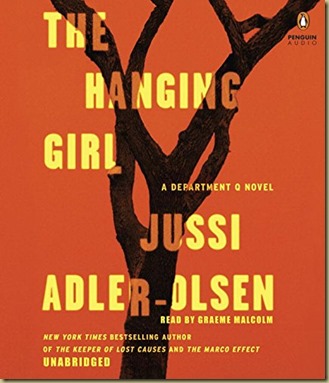
The Hanging Girl by Jussi Adler-Olsen


The Hanging Girl by Jussi Adler-Olsen - Thoughts in ProgressCases that appear bewildering and irrelevant to each other always find their way together in author Jussi Adler-Olsen’s Department Q psychological thrillers.

In the latest Department Q release – THE HANGING GIRL – narrator Graeme Malcolm does a superb job giving distinct voices to the various characters. His varying pitch and tone does well when switching from male to female characters. His is able to bring out the depth of emotions of the characters without over dramatizing the scene. His narration of the story brings the places and dialect of the area to life.

A cold case has haunted Sergeant Christian Habersaat for years so he contacts Danish Detective Carl Mørck, head of Department Q, for assistance. Carl informs the officer he can’t help him and a short time later the officer commits suicide. Carl is reluctantly then drawn in to solve Habersaat’s original cold case that involved a young woman apparently the victim of a hit-and-run driver.

It seems Habersaat had discovered the girl’s body hanging upside down from a tree nearly two decades ago. Treated as an accidental death all these years, Carl and his quirky group of assistants soon discover the girl had been murdered and their journey to find the true killer begins. Carl, Rose, Assad and newcomer Gordon have their hands full as they travel about putting the pieces together.
Meanwhile, a seeming unrelated story begins to unfold dealing with an eccentric sun-worshipping cult, its equally unconventional guru and a woman obsessed with him. 

Adler-Olsen has an uncanny way of pulling seemingly unrelated stories together with the most unique twists and turns. Just when you think you have it figured out, the author still has a few surprises in store to keep you on edge.
The characters are well-developed and likable. They’re presented in such a way you feel you know them like friends. Their interaction chemistry enhances the story and adds depth to the series.

THE HANGING GIRL is the sixth installment of the Department Q series to be published in the U.S. The book can be read or listened to on its own, but to fully appreciate the wacky misfits of Department Q the stories should be read in order.

This story has suspense, mystery, psychological tension and bits of humor throughout. Once again members of Department Q have proven they are a force to be reckoned with when it comes to solving cold cases no matter how disinclined Carl is to begin with.

The Hanging Girl by Jussi Adler-Olsen, A Department Q Novel Book #6, Narrated by Graeme Malcolm, Penguin Audio, @2015, ISBN: 978-1611764727, Unabridged, 13 Discs, Run Time: 15 Hours and 30 Minutes 

FTC Full Disclosure – A copy of this audio book was sent to me by the publisher in hopes I would review it. However, receiving the complimentary copy did not influence my review. The thoughts are completely my own and given honestly and freely.

Thanks for stopping by today. Are you a fan of Department Q and the crazy characters that make it up? Do you enjoy reading or listening to book written by authors from other countries set in those countries?

*This post contains affiliate links.

Wednesday, July 22, 2015

Blood Ties by Nicholas Guild


Blood Ties by Nicholas Guild - Thoughts in ProgressAuthor Nicholas Guild explores a different aspect of a serial killer in his latest psychological thriller, BLOOD TIES.

Guild explores the mind of the serial killer, but also his relationship with his son and the effects his madness has had on his son.

Young women are being brutally murdered in the San Francisco Bay Area. A lucky breaks leads homicide detective Ellen Ridley of the SFPD to believe she’s found a link to the killer. But as more evidence comes into play, Ridley discovers she has the killer’s son as her number one suspect.

Stephen Tregear, a hacker and code breaker for the military, has been tracking his father for years trying to stay one step ahead of him. Tregear ran away from home when he was a young boy after discovering a dead woman in the back of his father’s van.

Forming an unlikely bond, Ridley and Tregear team up to put a stop to Tregear’s father before he kills again. The elderly Tregear is also out to silence his son for good. 

The closer the duo get to the killer, the closer their attraction grows. The showdown between father and son heightens the surprise ending.

BLOOD TIES is a fast-pace, adrenaline-fueled thriller. The action is suspenseful and will keep you on the edge of your seat. The twists and turns will take you on a roller coaster ride of emotions.

Guild has created complex characters that will amaze you. Guild dives into the chilling world of a serial killer and takes readers on a hair-rising journey.

Author Nicholas Guild’s website is HERE.

Blood Ties by Nicholas Guild, Forge Books, @2015, ISBN: 978-0765378453, Hardcover, 320 Pages 

FTC Full Disclosure – A copy of this book was sent to me by the publisher in hopes I would review it. However, receiving the complimentary copy did not influence my review. The thoughts are completely my own and given honestly and freely.

Thanks so much for stopping by today. Have you ever stopped to think about the family of a serial killer? Do they know what’s going on? Would the killer hurt his own family if they did discover his acts of violence?

*This post contains affiliate links.

Friday, July 10, 2015

The Rules by Nancy Holder and Debbie Virguié


The Rules by Nancy Holder and Debbie VirguiĂ© - Thoughts in ProgressWhen I first saw THE RULES mentioned as a teen thriller, I almost didn’t read it. Boy, would that have been a huge mistake.

Turns out THE RULES is one of the best psychological thrillers I’ve ever read. Doesn’t matter it’s listed in the YA genre, it’s a fascinating read for all ages. It will keep you glued to your seat from beginning to end and even then it’ll leave you gasping.

The tension begins fast, holds you spellbound and throws you for a loop or two as the adrenaline rush accelerates. The alternating narratives will keep you in suspense as the good guys begin to look bad and the bad guys seem innocent.

When junior Robin Brisset has the opportunity to attend one of Callabrese High’s most exclusive parties, she knows it will be a memorable night. What she doesn’t realize is that the stakes will turn deadly during the party’s traditional scavenger hunt. Bending and breaking rules will become necessary for the partygoers to survive, that is if they can determine who to trust as they look for clues and a way out.

Authors Nancy Holder and Debbie Virguié have created unique characters that will defy your expectations. The dialogue moves from teen to teen in a fast pace, action-fueled transition. Each unexpected twist will shine new light on the characters and their motives.

This dark thriller is a must-read for those who enjoy spine-tingling tales with mysterious settings and captivating characters.

Author Nancy Holder’s website is NancyHolder.com and author Debbie VirguiĂ©’s website is DebbieVirguiĂ©.com

The Rules by Nancy Holder and Debbie VirguiĂ©, Delacorte Press Books, @2015, ISBN: 978-0385741002, Hardcover, 352 Pages 

FTC Full Disclosure – A copy of this book was sent to me by the publisher in hopes I would review it. However, receiving the complimentary copy did not influence my review. The thoughts are completely my own and given honestly and freely.

Thanks for stopping by today. Do you sometimes overlook a good book because it’s listed under a genre you don’t read? Would you not read a book just because it was listed YA?

*This post contains affiliate links.

Monday, January 26, 2015

The Girl on the Train by Paula Hawkins


The Girl on the Train by Paula Hawkins - Thoughts in ProgressStarting off as what seems to be ramblings, THE GIRL ON THE TRAIN grows to an obsession you can’t tear yourself away from until you have all the answers.

It’s been said, if you’re a Hitchcock fan you don’t want to miss this debut novel. I agree, but add that you should listen to the audio format to get a true Hitchcock experience.

The story is read by three narrators - Clare Curbett, Louise Brealey and India Fisher. Each does the voice of one of the three main characters – Rachel, Megan (aka Jess) and Anna. I’m not sure which narrator does which character, but all three do a superb job in their delivery. Their varied pacing and inflection matches the tension and suspense of the story. They each bring out the depth of emotions in the main characters, as well as the secondary characters. Through their mannerisms, they bring the characters to life in vivid detail for the listener.

This is a psychological thriller dealing with the lives of three women and how they intertwine in a most unusual way. 

Rachel, a lonely alcoholic, takes the same commuter train twice a day. It stops at the same signal every day near the home she used to share with her ex-husband. Rather than looking at her old house where her ex, his new wife and new baby girl live, Rachel watches the young couple that lives a few houses down the lane. She sees them living the perfect life she should have had with her ex-husband. She calls them Jess and Jason. One day as Rachel looks for Jess and Jason, she sees another man with Jess and they are kissing. Furious, Rachel can’t believe Jess is destroying her perfect life. Soon afterwards, Rachel learns the woman has disappeared.

Obsessed to help the man she calls Jason, Rachel decides to tell the police about the man she saw kissing Jess. From the news she learns the couple’s real names are Scott and Megan Hipwell. Because of Rachel’s alcohol problem, the police don’t consider her credible. Mixed with the stories her ex-husband’s new wife, Anna, is spreading and her blackout periods, Rachel begins to wonder what really happened to Megan/Jess.

Meanwhile, Megan’s story begins to unfold and dark secrets are revealed. In addition, Anna is upset that Rachel continues to call her ex-husband and comes by their house from time to time. Rachel has entangled herself in the other women’s lives and danger lurks around every corner. What really happens when she blacks out from too much alcohol? 

Author Paula Hawkins has crafted fascinating characters that take you on a suspenseful adventure. The twists and turns will keep you in the dark until the bombshell ending. Just as you think you have it figured out, Hawkins throws you for a loop. Seemingly strangers become like domino-effects as the search for the missing woman progresses.

THE GIRL ON THE TRAIN has the flavor of a Hitchcock story, but so much more. I started off thinking I wouldn’t be able to listen to the entire story and ended up I couldn’t stop listening to it. Without giving away any spoilers, let’s just say if you pass the same places everyday on your way to work, you may just look at them different after listening to this mesmerizing tale. Filled with mystery, suspense, intrigue, dark secrets, jealousy, and troubled souls, this is a story you won’t soon forget.

The Girl on the Train by Paula Hawkins; Narrated by Clare Curbett, Louise Brealey and India Fisher, Penguin Audio, @2015, ISBN: 978-1611763737, Unabridged, 9 Discs, Run Time: 11 Hours 

FTC Full Disclosure – A copy of this audio book was sent to me by the publisher in hopes I would review it. However, receiving the complimentary copy did not influence my review. The thoughts are completely my own and given honestly and freely.

Hope your Monday is going well and you’re not snowed (or iced) in with the blizzard hitting parts of the US. Are you a Hitchcock fan? What’s your favorite Hitchcock movie? Have you ever made a connection with someone you saw everyday on your way to work without ever really talking to them? Thanks so much for stopping by today. Hope I’ve enticed you check out THE GIRL ON THE TRAIN, especially the audio version – it’s amazing.

*This post contains affiliate links.

Sunday, September 8, 2013

Sunday Salon: A Commonplace Killing, The Wrong Girl


Can you believe it’s time for another Sunday Salon where we discuss the wonderful books we’ve discovered during the past week? Where has the time gone? There’s a nip in the air foretelling of autumn just around the corner. 

I have two amazing books to tell you about today. One is by a ‘new-to-me’ author and the other is the second installment in a wonderful new series by one of my favorite authors. First, the novel by the late SiĂ¢n Busby, an award winning novelist. Then the second book in the Jane Ryland series by award-winning author Hank Phillippi Ryan.

A COMMONPLACE KILLING by SiĂ¢n Busby

A Commonplace Killing - ImageThe events prior to the killing and the steps of the murder investigation are told simultaneously in author SiĂ¢n Busby’s last novel, A COMMONPLACE KILLING.


The late author beautifully weaves the past and the present in such a manner you don’t realize at first that the two events aren’t taking place at the same time. The story flows smoothly as it transitions keeping a steady pace.

This psychological thriller is set in post-World War II London and follows the double life of a seemingly proper middle-class woman, Lillian Frobisher. When Lillian’s body is found in an abandoned churchyard, it’s assumed she was the random victim of rape. Evidence shows she was strangled, but not raped.

It’s up to Divisional Detective Inspector Jim Cooper to find the person responsible for this ‘commonplace killing.’ Cooper begins to look into her private life and why her husband didn’t report her not returning home. What the DDI finds is a seedy double life the victim hid from her family and a postwar London that has none of the cheery optimism portrayed in newsreels.

A COMMONPLACE KILLING is suspenseful, intriguing and spellbinding as readers are taken back in time to London and the harsh reality of life after the war. Rich in history, the author’s vivid descriptions and details places the reader in the middle of the bombed landscape, the meager lifestyles and the broken promises.

The last 20 pages of the novel were transcribed from a handwritten manuscript following the author’s death. There is less intense descriptions and details in these pages, but at the same time carries the story just as well. In some ways, the stark contrast to the earlier rich embellishments makes the ending more dramatic.

Busby’s characters are well-developed with sharp contrast. They are courageous, yet flawed; broken, yet not without dreams. The author gives you a good sense of the time, place and the people trying to survive. The gripping story will hold your attention as you try to uncover the truth.

Busby has an alluring way of telling a story concerning a time I’ve always found difficult to read about. You might be tempted to read this story solely because the author died as she completed the work. However, I would recommend reading it solely because it is a psychological thriller that will captivate you with strong characters, rich descriptions and a well-balanced plot.
 
A Commonplace Killing by SiĂ¢n Busby, Atria Books/Marble Arch Press, @2013, ISBN: 978-1476730295, Paperback, 272 Pages


FTC Full Disclosure - This book was sent to me by the publisher in hopes I would review it. However, receiving the complimentary copy did not influence my review.
 
ABOUT THE AUTHOR:
I can not tell you about this fascinating novel and not tell you a bit about the author and how this story finally came to be published.
 
SiĂ¢n Busby, an award-winning writer, broadcaster and filmmaker, was married to BBC Business editor, Robert Peston, and the mother of two sons. She published four books, including THE CRUEL MOTHER, a memoir of her great-grandmother that won the MIND Book Award in 2004, and a novel, McNAUGHTEN, a highly acclaimed historical novel published in 2009.


Busby died in September 2012 after a long battle with cancer. Following her death, her husband transcribed her handwritten manuscript for the end of A COMMONPLACE KILLING. He did not known until reading the handwritten pages that she had completed the novel despite the toll the illness took on her in the end. Peston gives a beautiful tribute to this wife in the prefaces of the book and provides more about the story, as well as what sparked the idea for the novel.

THE WRONG GIRL by Hank Phillippi Ryan

The Wrong Girl coverOne of the things I especially enjoy about author Hank Phillippi Ryan’s Jane Ryland Series is how realistic her characters are, particularly her protagonist.

Narrator Ilyana Kadushin does an excellent job giving individual voices to the various characters in Ryan’s THE WRONG GIRL. Kadushin conveys the vast array of emotions the different characters experience. Her cadence holds your attention and heightens the drama of Ryan’s new suspense thriller.

Newspaper reporter Jane Ryland agrees to help former colleague Tucker Cameron with a personal issue concerning her adoption. Tucker has been reunited with her birth mother through the Brannigan Family and Children Service. However, she’s afraid she’s the wrong girl because of several items that were supposedly left with her when she was an infant.

Meanwhile, Detective Jake Brogan - Jane’s ‘sort of’ boyfriend - has his hands full investigating the murder of a woman that left two toddlers unharmed. In addition, Jake believes there had also been a baby at the scene and is now missing.

As Jane and Tucker search for answers to Tucker’s real birth mother, Jake’s murder investigation leads to the same adoption agency. When there are more murders and Jane is threatened, the cases collide turning the lives of several people upside down.
Ryan has a knack for creating realistic and likable characters. She gives them strength and courage, but also flaws and self-problems. The secondary characters are also well-developed adding depth and flavor to the story. 

The plot of THE WRONG GIRL flows smoothly and at a quick pace. While there are a number of things happening at once, the reader/listener isn’t lost in any confusion. The dialogue, as well as the bantering, among the characters pulls you in holding you captive as you try to figure out who the bad guys really are.

Ryan’s detailed descriptions of the locations enhances the story painting a vivid landscape of the setting. In addition, she brings out the true worries and fears print journalists face daily with cut backs and lay offs. Her own journalism background enriches the working aspects of this story. Her descriptions of Jane’s inability to get to the point of telling something without going into great deal hits home for this former newspaper journalist.

THE WRONG GIRL is a roller coaster ride of emotions topped off by suspense, humor and touches of romance. The action is heart-pounding, the characters memorable, and the intrigue spine-tingling.

The Wrong Girl by Hank Phillippi Ryan, A Jane Ryland Novel, Performed by Ilyana Kadushin, Macmillan Audio, @2013, ISBN: 978-1427232038, Unabridged, 11 Discs, Listening Time: 13.5 Hours 

FTC Full Disclosure - This audio book was sent to me by the publisher in hopes I would review it. However, receiving the complimentary copy did not influence my review.
 
Thanks for stopping by today. Hope you’re having a grand Sunday and finding time to do a bit of reading. Is there an era of history that you enjoy reading about more than others? What is your take on the adoption system?

Friday, May 24, 2013

On Tour: Cold Killing by Luke Delaney And A Giveaway


I’m delighted to be part of author Luke Delaney’s Partners in Crime Virtual Book Tour for his debut novel, COLD KILLING.

As part of the tour, I’ll tell you my thoughts on the book, give a brief bio of the author, tell you how you can win a copy of this tantalizing thriller, and share an excerpt from the book to see if it entices you as it did me.
ColdKilling_Banner

 COLD KILLING by Luke Delaney

Author Luke Delaney uses his law enforcement expertise to craft an authentic psychological thriller in his debut novel, COLD KILLING.

With the opening, Delaney reels you in causing you to speculate about the first character introduced. Then he leads you directly into a crime scene where you’re hooked wanting all the pieces of the puzzle at once.

With an unthinkable childhood driving him, Sean Corrigan turned his demons toward good becoming a detective inspector. With a fierce determination to protect the innocent, Corrigan is also able to identify the darkness in others. He understands it because it’s something that lies deep within himself.

Corrigan, responsible for South London’s Murder Investigation Team, catches an unusual case when a young man is found brutally murdered in his flat. At first glance it appears to be a domestic murder, but Corrigan soon finds other victims and a ruthless serial killer unlike any he has ever faced. The cunning killer changes his MO with each crime and never leaves the slightest trace of forensic evidence. But Corrigan has no doubt it’s the same killer and he quickly finds himself in a lethal game of cat and mouse.

COLD KILLING is an edge-of-your-seat read with the narrative switching between Corrigan and the killer. Readers are given glimpses of their personal lives to balance out this thriller.

ColdKilling_CoverDelaney has created well-developed, realistic characters that stay with you long after the last paragraph. He’s given them strength and weaknesses that readers can relate to. He shows police work at its best, along with the flaws and transgressions officers sometimes make. Delaney explores the forensic aspects of a crime and how the elements help and hinder an investigation.

Delaney’s years of experience as a police officer shine through in his eye for details for procedures, settings and characters interaction. His vivid descriptions of South London and the area, gives readers the feel they are there.

The story moves at a steady and smooth pace drawing the reader deeper into the minds of the killer and cop. The twists along the way will keep you guessing. The story is captivating, the characters mesmerizing. 

The ending was not what I was expecting, but fit perfectly. Delaney provides a touch of closure, but leaves readers anticipating what lies ahead for Corrigan and others. Get ready to lose track of time when you turn the first page of COLD KILLING. This is a gripping thriller and a great start for a fascinating new series. 
  
Cold Killing by Luke Delaney, Book 1 in the D.I. Sean Corrigan Series, HarperCollins, @2013, ISBN: 978-0062219466, Paperback, 448 Pages


FTC Full Disclosure - I requested this book as part of the author’s virtual book tour. A copy of the book was sent to me by the tour promoter in hopes I would review it. However, receiving the complimentary copy did not influence my review. 
 
ABOUT THE AUTHOR: Luke Delaney joined the Metropolitan Police Service in the late 1980s and his first posting was to an inner city area of South East London notorious for high levels of crime and extreme violence. He later joined CID where he investigated murders ranging from those committed by fledgling serial killers to gangland assassinations.

GIVEAWAY GUIDELINES
To enter this giveaway, send me an e-mail (mcbookshelf@gmail.com) with the subject line, “Win Cold Killing.” Your message should include your name and mailing address. The contest is open to residents of the U.S. and Canada. And, just so you know, I don’t share this information with anyone other than the publisher/promoter nor use it for any other purpose. The deadline to enter this giveaway for a chance to win a copy of COLD KILLING is 8 p.m. (EDT) on Sunday, June 2.


Thank you for stopping by today and visiting. Have you read many thrillers set in London lately? Does the difference in the terminology bother your reading?

EXCERPT:
Now here’s a little something to see if you are as captivated by the plot as I was. Happy reading!


    Saturday. I agreed to go to the park with the wife and children. They’re over there on the grassy hill, just along from the pond. They’ve fed themselves, fed the ducks, and now they’re feeding their own belief that we’re one normal happy family. And to be fair, as far as they’re concerned, we are. I won’t let the sight of them spoil my day. The sun is shining and I’m getting a bit of a tan. The memory of the latest visit is still fresh and satisfying. It keeps the smile on my face.

     Look at all these people. Happy and relaxed. They’ve no idea I’m watching them. Watching as small children wander away from mothers too distracted by idle chat to notice. Then they realize their little darling has wandered too far and up goes that shrill shriek of an overprotective parent, followed by a leg slap for the child and more shrieking.
     I am satisfied for the time being. The fun I had last week will keep me contented for a while, so everyone is safe today.


    Chapter 1
  
    Thursday

    It was 3 a.m. and Detective Inspector Sean Corrigan drove through the dreary streets of New Cross, southeast London. He had been born and raised in nearby Dulwich, and for as long as he could remember, these streets had been a dangerous place. People could quickly become victims here, regardless of age, sex, or color. Life had little value.

    But these worries were for other people, not Sean. They were for the people who had nine-to-five jobs in shops and offices. Those who arrived bleary eyed to work each morning, then scuttled home nervously every evening, only feeling safe once they’d bolted themselves behind closed doors.
    Sean didn’t fear the streets, having dealt with the worst they could throw at him. He was a detective inspector in charge of one of South London’s Murder Investigation Teams, dedicated to dealing with violent death. The killers hunted their victims and Sean hunted the killers. He drove with the window down and doors unlocked.
    He’d been asleep at home when Detective Sergeant Dave Donnelly called. There’d been a murder. A bad one. A young man beaten and stabbed to death in his own flat. One minute Sean was lying by his wife’s side, the next he was driving to the place where a young man’s life had been torn away.
    The streets around the murder scene were eerily quiet. He was pleased to see that the uniformed officers had done their job properly and taped off a large cordon around the block the flat was in. He’d been to scenes before where the cordon started and stopped at the front door. How much evidence had been carried away from scenes on the soles of shoes? He didn’t want to think about it.
    There were two marked patrol cars alongside Donnelly’s unmarked Ford. He always laughed at the murder scenes on television, with dozens of police cars parked outside, all with blue lights swirling away. Inside, dozens of detectives and forensics guys would be falling over each other. Reality was different.
    Entirely different.
    Real crime scenes were all the more disturbing for their quietness—the violent death of the victim would leave the atmosphere shattered and brutalized. Sean could feel the horror closing in around him as he examined a scene. It was his job to discover the details of death, and over time he had grown hardened to it, but not immune. He knew that this scene would be no different.
    He parked outside the taped-off cordon and climbed from the isolation of his car into the warm loneliness of the night, the stars of the clear sky and the streetlights removing all illusion of darkness. If he had been anyone else, doing any other job, he might have noticed how beautiful it was, but such thoughts had no place here. He flashed his identification to the approaching uniformed officer and grunted his name. “DI Sean Corrigan, Serious Crime Group South. Where’s this flat?”
    The uniformed officer was young. He seemed afraid of Sean. He must be new if a mere detective inspector scared him. “Number sixteen Tabard House, sir. It’s on the second floor, up the stairs and turn right. Or you could take the lift.”
    “Thanks.”
    Sean opened the boot of his car and cast a quick glance over the contents squeezed inside. Two large square plastic bins contained all he would need for an initial scene examination. Paper suits and slippers. Various sizes of plastic exhibit bags, paper bags for clothing, half a dozen boxes of plastic gloves, rolls of  sticky labels, and of course a sledgehammer, a crowbar, and other tools. The boot of Sean’s car would be mirrored by detectives’ cars across the world.
    He pulled on a forensic containment suit and headed toward the stairwell. The block was of a type common to this area of London. Low-rise tenements made from dark, oppressive, brown-gray brick that had been thrown up after the Second World War to house those bombed out of old slum areas. In their time they’d been a revelation—indoor toilets, running water, heating—but now only those trapped in poverty lived in them. They looked like prisons, and in a way that’s what they were.
    The stairwell smelled of urine. The stench of humans living on top of one another was unmistakable. This was summer and the vents of the flats pumped out the smells from within. Sean almost gagged on it, the sight, sound, and smell of the tenement block reminding him all too vividly of his own childhood, living  in a three-bedroom, public housing duplex with his mother, two brothers, two sisters, and his father—his father who would lead him away from the others, taking him to the upstairs bedroom where things would happen. His mother too frightened to intervene—thoughts of reaching for a knife in the kitchen drawer swirling in her head, but fading away as her courage deserted her. But the curse of his childhood had left him with a rare and dark insightfulness—an ability to understand the motivations of those he hunted.
    All too often the abused become the abusers as the darkness overtakes them, evil begetting evil—a terrible cycle of violence, virtually impossible to break—and so the demons of Sean’s past were too deeply assimilated in his being to ever be rid of. But Sean was different in that he could control his demons and his rage, using his shattered upbringing to allow him insights into the crimes he investigated that other cops could only dream of. He understood the killers, rapists, and arsonists—understood why they had to do what they did, could interpret their motivation—see what they saw, smell what they had smelled, feel what they had felt—their excitement, power, lust, revulsion, guilt, regret, fear. He could make leaps in investigations others struggled to understand, filling in the blanks with his unique imagination. Crime scenes came alive in his mind’s eye, playing in his head like movies. He was no psychic or clairvoyant; he was just a cop—but a cop with a broken past and a dangerous future, his skill at reading the ones he hunted born of his own dark, haunted past. Where better for a failed disciple of true evil to hide than among cops? Where better to turn his unique tools to good use than the police? He swallowed the bile rising in his throat and headed for the crime scene—the murder scene.
    Sean stopped briefly to acknowledge another uniformed officer posted at the front door of the flat. The constable lifted the tape across the door and watched him duck inside. Sean looked down the corridor of the flat. It was bigger than it had seemed from the outside. DS Donnelly waited for him, his large frame filling the doorway, his mustache all but concealing the movement of his lips as he talked. Dave Donnelly, twenty-year-plus veteran of the Metropolitan Police and very much Sean’s old-school right-hand man. His anchor to the logical and practical course of an investigation and part-time crutch to lean on. They’d had their run-ins and disagreements, but they understood each other—they trusted each other.
    “Morning, guv’nor. Stick to the right of the hallway here. That’s the route I’ve been taking in and out,” Donnelly growled in his strange accent, a mix of Glaswegian and Cockney, his mustache twitching as he spoke.
    “What’ve we got?” Sean asked matter-of-factly.
    “No sign of forced entry. Security is good in the flat, so he probably let the killer in. All the damage to the victim seems to have been done in the living room. A real fucking mess in there. No signs of disturbance anywhere else. The living room is the last door on the right, down the corridor. Other than that we’ve got a kitchen, two bedrooms, a bathroom, and a separate room for the toilet. From what I’ve seen, the victim kept things reasonably clean and tidy. Decent taste in furniture. There’s a few photies of the victim around the place—as best I can tell, anyway. His injuries make it a wee bit difficult to be absolutely sure. There’s plenty of them with him, shall we say, embracing other men.”
    “Gay?” Sean asked.
    “Looks that way. It’s early days, but there’s definitely some decent hi-fi and TV stuff around the place,  and I notice several of the photies have our boy in far-flung corners of the world. Must have cost a few pennies. We’re not dealing with a complete loser here. He had a decent enough job, or he was a decent enough villain, although I don’t get the feel this is a villain’s home.” Both men craned their heads around the hallway area, as if to confirm Donnelly’s assessment so far. He continued: “And I’ve found a few letters all addressed to a Daniel Graydon. Nothing for anyone else.”
    “Well, Daniel Graydon,” Sean asked, “what the hell happened to you? And why?”
     “Shall we?” With an outstretched hand pointing along the corridor, Donnelly invited Sean to continue.
    They moved from room to room, leaving the living room to the end. They trod carefully, moving around the edges so as not to disturb any invisible footprint indentations left in the carpets or minute but vital evidence: a strand of hair, a tiny drop of blood. Occasionally Sean would take a photograph with his small digital camera. He would keep the photographs for his personal use only, to remind him of details he had seen, but also to put himself back at the scene anytime he needed to sense it again, to smell the odor of blood, to taste the sickly sweet flavor of death. To feel the killer’s presence. He wished he could be alone in the flat, without the distraction of having to talk to anyone—to explain what he was seeing and feeling. It had been the same ever since he was a young cop, his ability to step into the shoes of the offender, be it a residential burglary or murder. Seeing the scene through the eyes of the offender. But only the more alarming scenes seemed to trigger this reaction. Walking around scenes of domestic murders or gangland stabbings he saw more than most other detectives, but felt no more than they did. This scene already seemed different. He wished he were alone.
    Sean felt uncomfortable in the flat. Like an intruder. As if he should be constantly apologizing for being there. He shook off the feeling and mentally absorbed everything. The cleanliness of the furniture and the floors. Were the dishes washed and put away? Had any food been left out? Did anything, no matter how small, seem somehow out of place? If the victim kept his clothing neatly folded away, then a shirt on the floor would alert Sean’s curiosity. If the victim had lived in squalor, a freshly cleaned glass next to a sink full of dirty dishes would attract his eye. Indeed, Sean had already noted something amiss.
    Sean and Donnelly came to the living room. The door was ajar, exactly how it had been found by the young constable. Donnelly moved inside. Sean followed.
    There was a strong smell of blood—a lot of blood. It was a metallic smell. Like hot copper. Sean recalled the times he’d tasted his own blood. It always made him think that it tasted exactly like it smelled. At least this man had been killed recently.  It was summer now—if the victim had been there for a few days the flat would have reeked. Flies would have filled the room, maggots infesting the body. He felt a jolt of guilt for being glad the man had just been killed.
    Sean crouched next to the body, careful to avoid stepping in the pool of thick burgundy blood that had formed around the victim’s head. He’d seen many murder victims. Some had almost no wounds to speak of, others had terrible injuries. This was a bad one. As bad as he’d seen.
    “Jesus Christ. What the hell happened in this room?” Sean asked.
    Donnelly looked around. The dining room table was overturned. Two of the chairs with it had been destroyed. The TV had been knocked from its stand. Pictures lay smashed on the floor. CDs were strewn around the room. The lights from the CD player blinked in green.
    “Must have been a hell of a fight,” Donnelly said.
    Sean stood up, unable to look away from the victim: a white male, about twenty years old, wearing a T-shirt that was 50 percent soaked in blood, and hipster jeans, also heavily soaked in blood. One sock remained on his right foot; the other was nowhere to be seen. He was lying on his back, the left leg bent under the right, with both arms stretched  out in a crucifix position. There were no restraints of any kind in evidence. The left side of his face and head had been caved in. The victim’s short hair allowed Sean to see two serious head wounds indicating horrific fractures to the skull. Both eyes were swollen almost completely shut and his nose was smashed, with congealed blood crusted around it. The mouth hadn’t escaped punishment, the lips showing several deep cuts, with the jaw hanging, dislocated. Sean wondered how many teeth would be missing. The right ear was nowhere to be seen. He hoped to God the man had died from the first blow to his head, but he doubted it.
    The pool of blood by the victim’s head was the only heavy saturation area other than his clothing. Elsewhere there were dozens of splash marks: on the walls, furniture, and carpet. Sean imagined the victim’s head being whipped around by the ferocity of the blows, the blood from his wounds traveling in a fine spray through the air until it landed where it now remained. Once examined properly, these splash marks should provide a useful map of how the attack had developed.
    The victim’s body had not been spared. Sean wasn’t about to start counting, but there must have been fifty to a hundred stab wounds. The legs, abdomen, chest, and arms had all been brutally attacked. Sean looked around for weapons, but could see none. He returned his gaze to the shattered body, trying to free his mind, to see what had happened to the young man now lying dead on his own floor. For the most fleeting of moments he saw a figure hunched over the dying man, something that resembled a screwdriver rather than a knife gripped in his hand, but the image was gone as quickly as it had arrived. Finally he managed to look away and speak.
    “Who found the body?”
    “That would be us,” Donnelly replied.
    "How so?"
    “Well, us via a concerned neighbor.”
    “Is the neighbor a suspect?”
    “No, no,” Donnelly dismissed the idea. “Some young bird from a few doors down, on her way home with her kebab and chips after a night of shagging and drinking.”
     “Did she enter the flat?”
    “No. She’s not the hero type, by all accounts. She saw the door slightly open and decided we ought to know about it. If she’d been sober, she probably wouldn’t have bothered.”
    Sean nodded his agreement. Alcohol made some people conscientious citizens in the same way it made others violent temporary psychopaths.
    “Uniform sent a unit around to check it out and found our victim here,” Donnelly added.
    “Did he trample the scene?”
    “No, he’s a probationer straight out of Hendon and still scared enough to remember what he’s supposed to do. He kept to the edges, touched nothing.”
    “Good,” Sean said automatically, his mind having already moved on, already growing heavy with possibilities. “Well, whoever did this is either very angry or very ill.”
    “No doubt about that,” Donnelly agreed.
    There was a pause, both men taking the chance to breathe deeply and steady themselves, clearing their minds, a necessary prelude before trying to think coldly and logically. Seeing this brutality would never be easy, would never be matter-of-fact.
    “Okay. First guess is we’re looking at a domestic murder.”
    “A lover’s tiff?” Donnelly asked.
    Sean nodded. “Whoever did this probably took a fair old beating themselves,” he added. “A man fighting for his life can do a lot of damage.”
    “I’ll check the local hospitals,” Donnelly volunteered. “See if anyone who looks like they’ve been in a real ding-dong has been admitted.”
    “Check with the local police stations for the same and wake the rest of the team up. Let’s get everyone together at the station for an eight a.m. briefing. And we might as well see if we can get a pathologist to examine the body while it’s still in place.”
     “That won’t be easy, guv.”
    “I know, but try. See if Dr. Canning is available. He sometimes comes out if it’s a good one, and he’s the best.”
    “I’ll do what I can, but no promises.”
    Sean surveyed the scene. Most murders didn’t take long to solve. The most obvious suspect was usually the right suspect. The panicked nature of the crime provided an Aladdin’s cave of forensic evidence. Enough to get a conviction. In cases like this, detectives often had to do little more than wait for the laboratory to examine the exhibits from the scene and provide all the answers. But as Sean looked around something was already niggling away at his instincts.
    Donnelly spoke again. “Seems straightforward?”
    “Yeah, I’m pretty happy.” He let the statement linger.
    “But . . . ?”
    “The victim almost certainly knew his killer. No forced entry, so he’s let him in. A boyfriend is a fair bet. This smells like a domestic murder. A few too many drinks. A heated argument. A fight kicks off and gets nastier and nastier, both end up beaten to a pulp and one dies. A crime of passion that the killer had no time to prepare for. He’s lost it for a while, killed a friend. A lover. Now all he wants to do is run. Get away from this flat and be somewhere safe to think out his next move. But there’re a couple of things missing for me.”
    “Such as?”
    “They’ve probably been having a drink, but there are no glasses anywhere. Can you remember dealing with a domestic murder where alcohol wasn’t involved?”
    “Maybe he cleaned the place up a bit?” Donnelly offered. “Washed the glasses and put them away.”
    “Why would he bother cleaning a glass when his blood and fingerprints must be all over the place after a struggle like this?”
    “Panic?” Donnelly suggested. “Wasn’t thinking straight. He cleaned up his glass, maybe started to clean up other stuff too before he realized he was wasting his time.”
    “Maybe.”
    Sean was thinking hard. The lack of signs of alcohol was a small point, but any experienced detective would have expected to find evidence of its use at a scene like this. An empty bottle of cider. A half-empty bottle of Scotch, or a champagne bottle to fuel the rage of the rich. But it was the image he was beginning to visualize that was plaguing him with doubt—the image his mind was piecing together using evidence that was missing as much as evidence that was present. The image of a figure crouching very deliberately over the victim. No frenzy, no rage, but evil in a human form.
    “There’s something else,” he told Donnelly. “The killing obviously took place in the living room. We know he must have gone out the front door because everything else is locked up nice and tight. But the hallway is clean. Nothing. The carpet is light beige, yet there’s no sign of a bloody footprint. And the door handle? Nothing. No blood. Nothing.
    “So our killer beats and stabs the victim to death in a frenzied moment of rage and yet stops to clean his hands before opening any doors. After killing a man who may have been his lover, he’s suddenly calm enough to take his shoes off and tiptoe out of the place. That doesn’t make a lot of sense.”
    Donnelly joined in. “And if our boy did stop to clean himself up before leaving, then where did he get clean? He had two choices. The sink in the bathroom or the sink in the kitchen.”
    Sean continued for him. “We’ve seen both of them. Clean as a whistle. No signs of recent use. Not even a splash of water.”
    “Aye,” Donnelly said. “But it’s probably nothing. We’re assuming too much. Maybe forensics will prove us wrong and find some blood in the hallway we can’t see.”
    Sean wasn’t convinced, but before he could reply the uniformed constable at the front door called into the flat. “Excuse me, sir, your lab team is here.”