 It’s always a pleasure to welcome author Libby Sternberg back to Thoughts. Today she joins us to talk about her novel, AFTER THE WAR (now available in print and for Kindle) and research she did for the book.
In addition, Libby has a surprise to share with readers during her post about this intriguing book.
Here’s a brief synopsis of AFTER THE WAR:
A decade after the war, its devastation still haunts them...
It’s always a pleasure to welcome author Libby Sternberg back to Thoughts. Today she joins us to talk about her novel, AFTER THE WAR (now available in print and for Kindle) and research she did for the book.
In addition, Libby has a surprise to share with readers during her post about this intriguing book.
Here’s a brief synopsis of AFTER THE WAR:
A decade after the war, its devastation still haunts them...
In the summer of 1955, a young nun awakens in Johns Hopkins Hospital after suffering an overdose, unable to remember the events that brought her there. As she recovers, she becomes the center of quiet struggles among those who surround her: her brother, a former GI still stung by betrayal during his years of service; her sister-in-law, a beautiful woman seeking love at any price; her confessor, a Jesuit priest who lost everything during the bombing of London; her nurse, a war widow whose sunny optimism leads to repeated disappointment; and her doctor, a psychiatrist beset by survival guilt and doubts about his profession's ability to heal.
Suffering from unseen war wounds ten years after the fighting ended, they each find their way to a very personal peace.
Here’s what Christy English, author of THE QUEEN’S PAWN, had to say about AFTER THE WAR - "...a touching novel of faith and family...an evocative story of love lost, and found, told with beautiful language and emotional clarity. A novel to savor."
Libby joins us to talk about ‘Researching the life of nuns in the 1940s and ’50s.’
Although my novel AFTER THE WAR follows several characters who, ten years after the end of World War II, are still dealing with the aftereffects of worldwide conflict, a key player around whom most of the action revolves is a young nun, Sister Francis Marie (born Margaret Wojehedski). Sister Francis Marie finds herself in the mental ward of a hospital, unable to remember the overdose that landed her there.
Writing the story of Sister Francis Marie led me to do quite a bit of research on orders of nuns, their various rules, and how their sisters led their lives. I myself had been taught by nuns from the Order of St. Francis in both elementary and high school years. I lived through the days when sisters wore heavy, voluminous habits and had little interaction—even as teaching sisters—with the outside world. Beyond this, however, I didn’t know anything about how they lived. The convent we passed every morning on our way into school was a house of mysteries.
Books provided my first resource for material. I read several memoirs of nuns who’d left their convents. And, of course, I read the well-known Nun’s Story and watched numerous times the wonderful movie of the same title starring Audrey Hepburn.
Each of these resources helped me construct the fictional order of nuns in my novel. From one memoir I learned of an order of nuns that was so strict about family contact that nuns had to choose between a visit to a deathbed or a visit for the funeral of a loved one. From another memoir, I learned of the practice of some sisters in one particular order eating more of the foods they disliked than the ones they liked.
But some of my best research was done in an interview with a nun who’d taught in my elementary school, Sister Ann Marie Slavin. 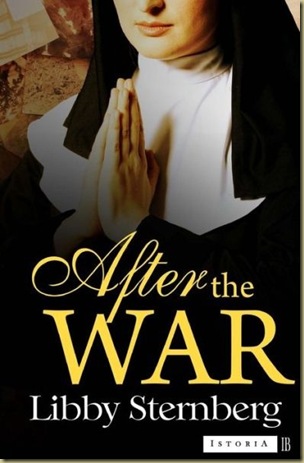 I’d never had her as a teacher—my own sister had—but we found each other when she read one of my first books. Then, we friended each other on Facebook. I told her I was writing a novel featuring a nun and asked if I could chat with her. What a wonderful conversation that was!
Sister Ann Marie Slavin entered the convent in 1959, four years after my fictional nun faced her very personal crisis. But the convent of 1959 was very similar to the one my character found herself in as she recalled her postulancy and novitiate. Sister Ann Marie filled in gaps for me and gave me extra telling details—such as how hot the habits of those days really were, how she personally struggled with keeping the linen pieces neat and flat, and how happy she was when the Second Vatican Council ushered in a new era of looser habits during the late 1960s and early 1970s. She also shared with me the fact that in her order, at least, they were not allowed to read novels—fiction of any kind!—for a long time. But she had a very kind mother superior who saw fit to break that rule with books such as Shoes of the Fisherman, a tale of a fictional pope.
By the time I spoke with Sister Ann Marie, my writing journey with AFTER THE WAR was nearly a decade old. I’d started the book years ago, focusing almost solely on my made-up Sister’s life and that of her sister-in-law, a Mary-Magdalene-like character who is searching for love more than faith. The story had never seemed quite right, however, so I kept putting it aside and coming back to it. Finally, I realized that I couldn’t tell Sister’s story without telling the stories of those who try to help her, including her doctor, nurse, and other members of her family.
This changed the outlook of the book somewhat, shifting it from an Everyman approach to faith and love to one that included reconciliation. Each character has been affected by the war. And each must walk their own healing journey toward forgiveness and acceptance. Discovering this theme was a “eureka” moment for me. Of course, I thought, of course this is the thread connecting each story.
I’m a baby boomer, so my parents’ generation came of age during the war. Even though my generation was born after it was over, we lived in its shadow—or, perhaps more precisely, in its sunlight, great drenching sunshine after years and years of dreadful grimness. My youth always felt to me as a collective sigh of relief: it’s over, the war is over.
I hope you enjoy AFTER THE WAR. It’s free today, July 8, at the Kindle store as part of a promotion. If you take advantage of this free offer, please consider penning a review or letting me know what you thought of the story!
Libby, thanks so much for joining us again and for sharing how this story came about. The life of nuns is quite intriguing and you’ve woven these characters together for a well-balanced story. Thanks also for sharing that AFTER THE WAR is FREE today!!
For those who haven’t meet Libby before, here’s a bit of background on her. She is the author of several historical novels and she was nominated for an Edgar for her first book, a teen mystery.
Her retelling of the Jane-Eyre story, SLOANE HALL, set in old Hollywood, has been praised as "An original story with complex character development...(Sternberg) knows how to tell a story and she does it well....a refreshing tale" by Carolyne Van Der Meer, Bronte Studies Journal.
For more on Libby and her writing, visit her website at http://www.libbysternberg.com/
Thanks everyone for visiting today. Do you enjoy books where you learn about other cultures and lifestyles, while being entertained with a delightful story?
I’d never had her as a teacher—my own sister had—but we found each other when she read one of my first books. Then, we friended each other on Facebook. I told her I was writing a novel featuring a nun and asked if I could chat with her. What a wonderful conversation that was!
Sister Ann Marie Slavin entered the convent in 1959, four years after my fictional nun faced her very personal crisis. But the convent of 1959 was very similar to the one my character found herself in as she recalled her postulancy and novitiate. Sister Ann Marie filled in gaps for me and gave me extra telling details—such as how hot the habits of those days really were, how she personally struggled with keeping the linen pieces neat and flat, and how happy she was when the Second Vatican Council ushered in a new era of looser habits during the late 1960s and early 1970s. She also shared with me the fact that in her order, at least, they were not allowed to read novels—fiction of any kind!—for a long time. But she had a very kind mother superior who saw fit to break that rule with books such as Shoes of the Fisherman, a tale of a fictional pope.
By the time I spoke with Sister Ann Marie, my writing journey with AFTER THE WAR was nearly a decade old. I’d started the book years ago, focusing almost solely on my made-up Sister’s life and that of her sister-in-law, a Mary-Magdalene-like character who is searching for love more than faith. The story had never seemed quite right, however, so I kept putting it aside and coming back to it. Finally, I realized that I couldn’t tell Sister’s story without telling the stories of those who try to help her, including her doctor, nurse, and other members of her family.
This changed the outlook of the book somewhat, shifting it from an Everyman approach to faith and love to one that included reconciliation. Each character has been affected by the war. And each must walk their own healing journey toward forgiveness and acceptance. Discovering this theme was a “eureka” moment for me. Of course, I thought, of course this is the thread connecting each story.
I’m a baby boomer, so my parents’ generation came of age during the war. Even though my generation was born after it was over, we lived in its shadow—or, perhaps more precisely, in its sunlight, great drenching sunshine after years and years of dreadful grimness. My youth always felt to me as a collective sigh of relief: it’s over, the war is over.
I hope you enjoy AFTER THE WAR. It’s free today, July 8, at the Kindle store as part of a promotion. If you take advantage of this free offer, please consider penning a review or letting me know what you thought of the story!
Libby, thanks so much for joining us again and for sharing how this story came about. The life of nuns is quite intriguing and you’ve woven these characters together for a well-balanced story. Thanks also for sharing that AFTER THE WAR is FREE today!!
For those who haven’t meet Libby before, here’s a bit of background on her. She is the author of several historical novels and she was nominated for an Edgar for her first book, a teen mystery.
Her retelling of the Jane-Eyre story, SLOANE HALL, set in old Hollywood, has been praised as "An original story with complex character development...(Sternberg) knows how to tell a story and she does it well....a refreshing tale" by Carolyne Van Der Meer, Bronte Studies Journal.
For more on Libby and her writing, visit her website at http://www.libbysternberg.com/
Thanks everyone for visiting today. Do you enjoy books where you learn about other cultures and lifestyles, while being entertained with a delightful story?

Thanks for having me here once again. This is a terrific place for authors and readers. In fact, I’ve been here as your guest as an author in the past, trying to promote various books.
But today I’m here to talk about a new ePress I’m starting--Istoria Books.
It’s no secret that sales of eBooks are growing. Just recently the New York Times ran an article about how young adult eBook sales now make up a quarter of those books sold by HarperCollins. Other publishers (and genres) report similar expansion in the eBook market.
Some authors are taking advantage of this market expansion by putting their books for sale on amazon and the like themselves. I salute them. It’s a tough slog to get your book professionally edited and formatted, to secure cover art and to handle ISBN registration, insurance and marketing.
For authors who don’t want to deal with all that work, Istoria Books offers an alternative. We’re a selective publisher, so you won’t be “self publishing” with us. We split royalties rather than pay advances, but we do not ask authors to “earn out” the costs of production. We cover those ourselves.
We want Istoria to be a place where readers can always find “Books you want to read at prices you want to pay.”
What does “books you want to read” mean? I think all readers, myself included, far too regularly encounter books they don’t get into, they don’t want to finish. Or, if they do want to finish the story, they just skip to the end to see how things wrap up.
While we understand that reading tastes are very subjective (and you can’t please everyone all the time), Istoria Books seeks to find stories you don’t want to give up on--good yarns. We want to find stories that you want to hear the author tell--you don’t just flip to the end to see what happens.
We suspect that some of these stories might have a hard time finding print publishers because of the marketing limitations traditional publishers face. They’re under tremendous pressure to find predictable successes. No wonder then that you see book after book with Tudor ladies on the cover (curiously, without faces!) or vampires or …whatever the bestselling trend happens to be.
Istoria Books can afford to take some chances on different kinds of stories. As we say in our submission guidelines, if your romance is told from the hero's POV, we'll still look at it. If your young adult novel features a college-age protagonist, we'll consider it. If your women's fiction book puts romance way on the back burner, we're open to it. If your inspirational involves a sinning protagonist, we'll still take a look.
The two questions we ask when reviewing manuscripts are: do I want to keep reading this story, and do I want to keep hearing this author tell it to me? A good story, well-told.
We hope authors will check out our submission guidelines, at the “About Us” page on our website--www.IstoriaBooks.com. We hope readers will check out our offerings and get on our mailing list by signing up at our website or blog (www.IstoriaBooks.blogspot.com). Freebies and discounts will be available at various time to our subscribers.
In fact, Istoria Books is pleased to announce acquiring digital rights to Gary Alexander’s up-market/literary fiction DRAGON LADY.
Set in 1965 Saigon on the eve of the big troop build-ups in Vietnam, DRAGON LADY is bittersweet, funny, absurd and heartbreaking all at once, telling the story of a young draftee’s obsession with a Vietnamese woman, who could betray him in more ways than one. Gary’s intelligent voice--filled with dry wit--and his own experiences give this story a sharp sense of truth--the “truth within the lie” that all good fiction is. Gary served in Vietnam in ’65. When he arrived, he joined 17,000 GIs. When he left, 75,000 were in country.
Watch for news of the release of DRAGON LADY soon!
Libby, thanks for guest blogging here today and sharing your information on Istoria Books. The ebook world is expanding fast and each day I’m understanding more and more good points about it.
What are your thoughts on ebooks and publishing?

Some may know Libby as Libby Malin. But, she's here today as Libby Sternberg and her latest release is SLOANE HALL. Libby’s offering a copy of her new release to one visitors today. Be sure to see the guidelines at the end of her post. She’s here today to tell us.....….hush, a secret about SLOANE HALL.
My fall historical, SLOANE HALL, was inspired by one of my favorite novels, JANE EYRE. But in SLOANE HALL, I wanted to tell a fresh story so that readers would encounter the tale as if they’d never read it before. It was a challenge, one I’ve blogged about on several occasions hither and yon. As I observed on one of those blogs, I didn’t want to write a point-by-point retelling of Bronte’s classic because if readers want to read JANE EYRE….they’ll read JANE EYRE.
So in SLOANE HALL, the setting is shifted to 1929 Hollywood where chauffeur John Doyle falls in love with his employer, Pauline Sloane, a starlet about to make her first talking picture. Before they can claim happiness, he is repulsed by secrets she hides from the camera and the world. Although it’s inspired by JANE EYRE, SLOANE HALL tells a new story of obsession and forgiveness.
Readers who are familiar with JANE EYRE and who pick up SLOANE HALL should be able to recognize what I call “benchmark” moments from the original—the first meeting of Jane and Rochester, Jane’s departure for her aunt’s house, the wedding and its horrible revelations, Jane’s heartbreak and self-exile from Thornfield Hall, and eventually her return after hearing Rochester calling her back from afar.
For me, these moments (along with several other key scenes) represent the emotional high and low points of Bronte’s original. They, I believed, would be the scenes JANE EYRE fans would eagerly await if they were reading a retelling, or a book such as SLOANE HALL, one that was inspired by JANE EYRE.
Each of those moments contains an element of surprise, however. And for readers familiar with the original story, creating that sense of surprise was a tremendous challenge. In some instances, I relied on the change in setting and tone to help me. Other times, I let my fresh characters lead me down slightly different paths.
When John visits his dying grandfather (as Jane visited her ailing aunt), for example, he wrestles with his obsession with Pauline Sloane, his employer, hoping a deathbed will rid him of his desire for her. But he also uses the visit to learn more about her past since she grew up in San Francisco, where his grandfather now resides.
Later, after John has left Sloane Hall following his discovery of Pauline’s secrets, he lands at a distant cousin’s house in Montana. There, he eventually “hears” Pauline calling to him for help, but I hope it is in an unexpected way—even if readers suspect they know how it will happen, I hope it still surprises them.
And, of course, the “lunatic spouse in the attic” scene in JANE EYRE is handled differently in SLOANE HALL as well. There are secrets that sicken John and drive him away, yes, but a lunatic spouse? Well….I can’t give that away here, but I hope this scene packs the emotional punch of the original.
One secret I will reveal here, though, relates to Pauline Sloane’s name. In the novel, her real name, before the studios changed it, is Eleanor Brickman. Astute observers will remember that Rochester’s first wife was Bertha Mason. Mason…Brickman…yes, I wanted Pauline to be an amalgam of both Rochester and Bertha, embodying the fierce independence and gruffness of Rochester and the torment and madness of Bertha.
I hope I succeeded. I’ve been heartened to receive some lovely reviews of SLOANE HALL so far. Romance Reviews Today says it’s “well worth reading,” while Fresh Fiction reports that “Sternberg never loses sight of the story she's re-telling, but this novel is definitely her own. Readers have things to figure out and look forward to. Her prose flows beautifully with vivid descriptions of people and places, bringing to life a Los Angeles of times gone by. Fans of historical fiction and JANE EYRE in particular will relish this novel, and readers who enjoy a love story should definitely pick this one up.”
Those who comment on this blog within the next 24 hours will have their names entered into a random drawing for a free copy of SLOANE HALL.
Libby, thanks so much for stopping by today and sharing some secrets with us. SLOANE HALL sounds most intriguing and a very interesting read. I’m looking forward to it.
Libby is the author of YA mysteries (the first of which was an Edgar nominee) and women’s fiction. As I mentioned earlier, she also writes as Libby Malin (MY OWN PERSONAL SOAP OPERA). You can visit her blog at www.LibbysBooks.wordpress.com (where she blogs about SLOANE HALL, old Hollywood, JANE EYRE and more), or her website at www.LibbysBooks.com . You can friend her on Facebook at Libby Sternberg, or contact her to get on her mailing list at Libby488 (at) yahoo (dot) com.


